Showing posts with label Bentley Road. Show all posts

Wednesday, January 26, 2022

Oh, To Soar Like an Eagle, or... To Kite Like a Kite!

You just never know when a moment of beauty and grandeur will happen. People look at me strangely whenever I go out the door on a mundane errand with my camera in tow, but I've missed too many such moments to ever want to be caught without the camera.
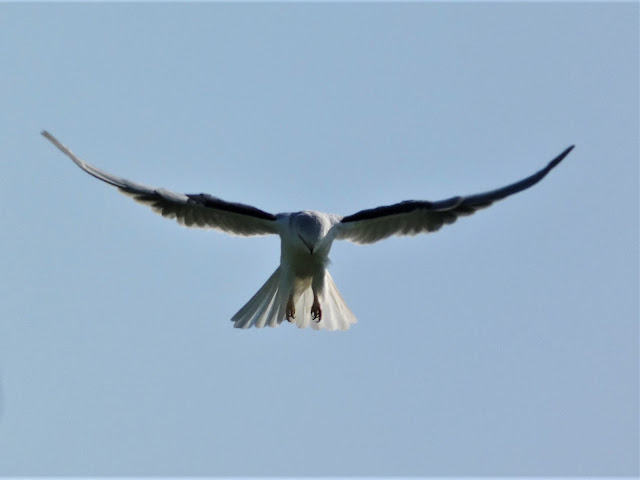
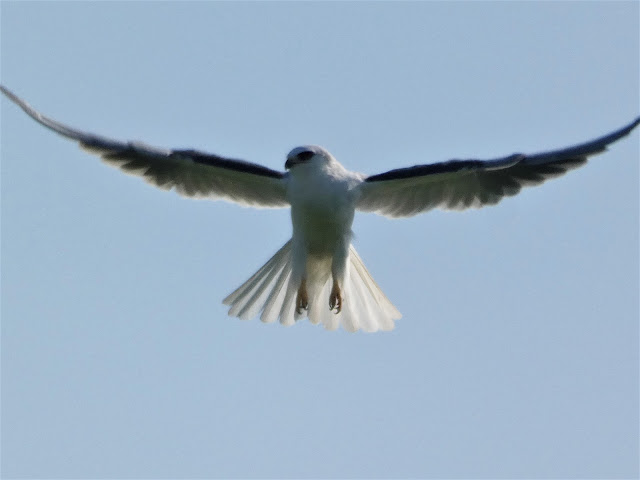
So today it was the pharmacy and the grocery store. We live in an outlying area where the locals refuse to wear masks and get vaccinated, so I headed into the big town, passing a local farm road called Bentley Road. It's still mostly ranching lands, so the prairie birds can often be seen there by birders. It was there that I spied my first White-tailed Kite (Elanus leucurus) of the year, and it was doing what Kites are famous for doing: kiting. That's the talent of hovering in place over the fields to catch the hard-to-spy movements of small rodents and other creatures. Birds in flight are pretty hard to photograph, but a kiting Kite at least stays in one spot while flapping its wings.
The White-tailed Kite is neither rare nor common in our area. The reports for the new year number fewer than ten. I'll see them a few dozen times this year perhaps, but nowhere near the number of times I'll see the Red-tailed Hawks. They have a limited range in the United States, extending through California, parts of the Oregon coast, and a bit of southern Texas. They are beautiful birds, and my breath catches just a little whenever I spy one.

The Kite was kind enough to stay motionless long enough for me to grab the camera and snap a few pictures. I didn't have the time to see if this particular hunt was successful.

I was thinking the Kite was behaving like a drone, but Kites have been around far longer than drones. The proper historical attitude would be that drones are just basically artificial Kites.

 

Sunday, August 29, 2021

Why do they call it a White-Tailed Kite? And why do I take my camera EVERYWHERE?


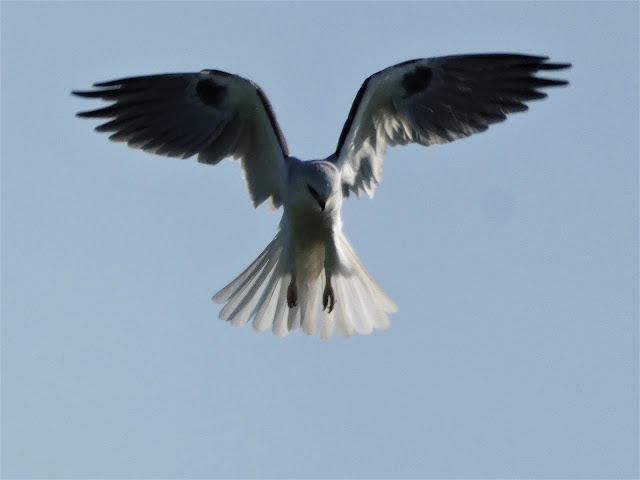
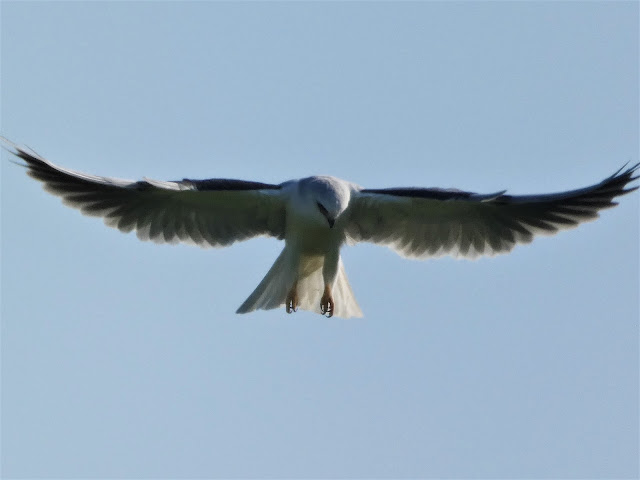
Really, both of the questions in the title are easily answered. It's called a White-tailed Kite (Elanus leucurus) because it has a white tail, and it kites. If you are unfamiliar with the term, it's maybe more related to kites that you fly with a string and all because the appearance is much the same. Kites are known for their habit of flying in place without moving as if they were attached to a string, watching for prey in the grassy fields below. A few other birds do it, but these birds are real masters. And they are my favorite raptors.
Strangely enough, today's pictures happened because another bird was kiting in the pasture-lands along Bentley Road east of Modesto. I couldn't see it well because of the sun angle, so I stopped to get the binoculars. It turned out to be an American Kestrel, but then I noticed there was a Kite on the fence post not forty feet from my car.
The camera was on the seat beside me, but the windows blocked a good angle for getting photos. I inched the car forward and raised the camera, but just as I clicked it flew away. I said to myself "of course" because that's what always happens, but to my great surprise, it simply flew across the road and landed just a bit behind me, no more than eighty feet away. And it was contentedly munching on lunch, which was some kind of small rodent. I took around 35 pictures because no Kite has ever allowed me to be so close. These are the best pictures I've ever been lucky enough to capture. It actually took me several minutes to realize there were two more Kites out in the meadow beyond the first.
And that brings up answer to the second question: Why do I take my camera EVERYWHERE? Because you never know what will happen when you are out and about. I was simply out to get a few things at the grocery store. If I had not brought the camera, I would have missed these shots.


Thursday, March 21, 2019

Long-billed Curlew on the Artificial Prairie of Bentley Road

Here's a beauty of the process of evolution. The general activity in ecosystems is that everything that is alive eats other things that are alive, and everything that is alive tries not to be eaten. Evolution favors those organisms that are best adapted to survive in a given environment, even if they end up looking "weird". There are lots of birds and other creatures that like eating insects and worms that live in the soil, and some soil-based organisms have adapted to this fact by burrowing deeper into the soil, where they can't be accessed. Except for birds like the Long-billed Curlew (Numenius americanus). The bill is so long as to look almost ridiculous, but those extra inches provide the Curlew with the ability to delve deep into the mud or soil that others can't reach.
A huge flock of Long-billed Curlews have been spending the winter in some pasture-lands along Bentley Road near the town of Riverbank in the Great Valley. It's one of those rare grasslands that hasn't been plowed up and planted with almonds. The few times I've seen them they've numbered in the hundreds, but some birders report seeing several thousand at a time. It's a pretty incredible sight.
I got a minute of video showing them working the grass. If I were a worm, I'd be terrified...