Showing posts with label Tuolumne River Parkway. Show all posts

Monday, May 22, 2023

Two Uncommon Birds on the Tuolumne River Parkway Today

It was a delightful day on the Tuolumne River Parkway Trail. I was on the trail early, so it was cool, and the river is still running at flood stage (a controlled flood, given the presence of a giant dam a few miles upstream), so there was more river noise than traffic. I've always had trouble hearing birds, but with hearing aids and the Merlin bird app, I've been making headway in learning some of the calls. I was at the western end of the trail when the app said there was a Blue Grosbeak (Passerina caerulea) calling. I get false alarms on the app quite often so I started it again, and the Blue Grosbeak popped up, again and again. I finally realized I was hearing it on my own too (not used to those hearing aids yet).

But I couldn't see it. It had to be close by, but aids boost sound, but don't necessarily provide directional capability. I finally caught it at the very top of a nearby oak tree, and caught a few pictures like the one above.

Why was this special? They are at the top of my list of favorite birds, but I don't see the Blue Grosbeaks very often. There've only been six or seven of them seen in the entire county so far this year, and I've only seen them on the Tuolumne Trail once before, in 2020. So that made for a fine moment.

But it wasn't the only one. There was another rare visitor on the trail today. It's also uncommon because we are on the migratory path between their wintering areas in Central America, and their breeding areas in the Artic and northern tier US states (although a few seem to breed locally). It was an Olive-sided Flycatcher (Contopus cooperi). Unlike the Blue Grosbeak, it is a dependable visitor, having shown up along the Tuolumne Trail at least once in each of the last six years. But I will typically see it no more than a few times in a season, so it was kind of neat to see both birds on the same day. And to have them both pose for a few pictures (especially the flycatcher with the nice tuxedo vest)!
The Olive-sided Flycatcher has suffered a huge drop in population since 1970, nearly 80%. Habitat loss seems to be the heart of the problem, as forests have disappeared in the bird's wintering grounds. I'm glad that parts of the Tuolumne River corridor remain for them to hopefully thrive into the future.
 

Monday, April 17, 2023

A Rare Treat on the Tuolumne River: Lawrence's Goldfinches

It's a bird I had seen only one time previously, and there was a good reason for it. The Lawrence's Goldfinch (Spinus lawrencei) is a fickle species. They have a somewhat limited range, mostly across central and southern California, southern Arizona, and northern Mexico.

Source: https://www.allaboutbirds.org/guide/Lawrences_Goldfinch/overview
They tend to be a nomadic species, following the availability of water and seeds, so they are rarely a sure thing if you happen to be looking for them. I saw them once at Turlock Lake in 2020, but nowhere else since then. Until late March that is.
Most of the bluffs above the Tuolumne River Parkway Trail where I walk most days are covered with a thick carpet of non-native grasses and weeds, but when they completed work on the Hickman Bridge last year, the new bridge abutments were planted with some native shrubs and wildflowers, and I had noticed a great many Lesser and American Goldfinches hanging out there, so I took a closer look. I wasn't really expecting to see any Lawrence's Goldfinches, but I knew it never hurts to look. And then I saw some strange coloration: gray.
The other goldfinches tend towards bright yellows and olive-green colors, so I started snapping pictures. I kind of knew I might not get another chance, given their nomadic ways. But a week later I was back, and so were the Lawrence's Goldfinches. There were at least three of them and possibly more, and they seemed happy with the site.

I don't know how long they will be sticking around, but I'll be enjoying watching them while they're here. It would be interesting to see if they'll nest in the area this summer.

I have a sense that bird numbers are up this year, no doubt due to the huge amount of precipitation with the accompanying growth of grasses and availability of insects (it has been a bit buggy on the trail these last few weeks, and the swallows and swifts are especially loving it). 
If you live in the area and want a chance to see them, it's not too hard to access the spot. They've mainly been around the planted areas beneath and on both sides of the new Hickman Bridge in Waterford. The River Park (Appling Park) on the east side of the bridge offers the closest parking, with a walking distance of only a hundred yards or so on level ground. They are supposedly the most active in the morning and evening hours (I've mostly seen them in the afternoon).

More info about these beautiful birds can be found at https://www.allaboutbirds.org/guide/Lawrences_Goldfinch/overview.


Tuesday, March 8, 2022

A Merlin on the Tuolumne River, for the Second Time This Year

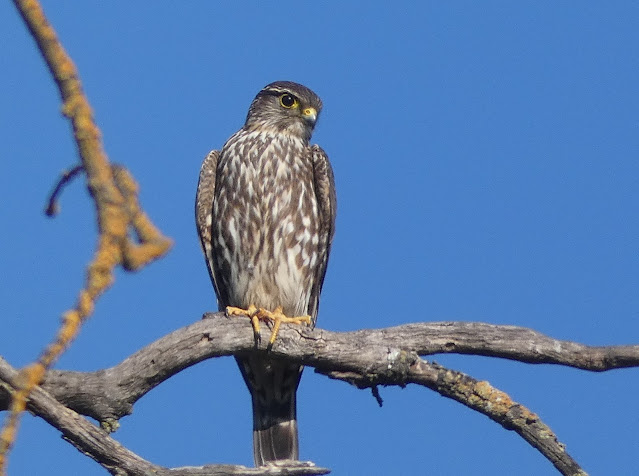
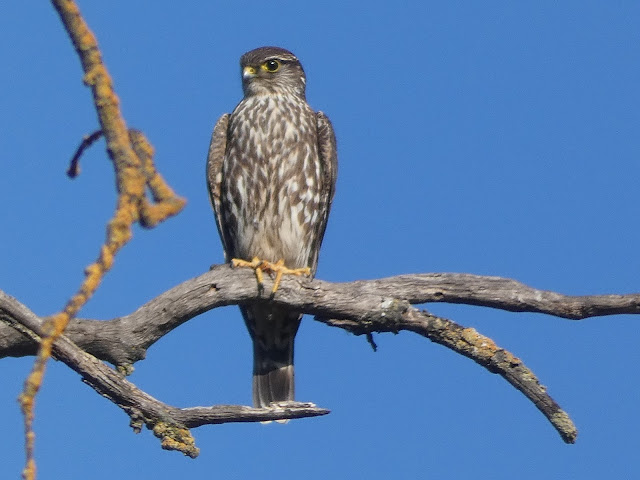
I didn't post about this back in January for plenty of reasons, too busy with school starting, and lousy pictures, but Merlins (Falco columbarious) have been visiting the Tuolumne River Parkway Trail this year. I saw one on January 6 which was gloomy and dark and not conducive for picture-taking, but the only other time was way back in 2018. But today was perfect weather, and the Merlin was cooperating by perching out in the open where I could get a few decent pictures.


Merlins are the 'Lady Hawks' of Medieval times, but they are actually falcons, and like other falcon species, they have been used by falconers for years for hunting and hobby purposes. They underwent a severe decline because of the use of DDT in the fifties and sixties, but they have recovered nicely since the pesticide was outlawed. 

It was a pleasant surprise to see one today.

Saturday, October 3, 2020

The Tale of Really Lost Bird: A Tropical Kingbird (probably) on the Tuolumne River Parkway Trail

There was this bird this morning. It was way out of place, but for more reasons than I realized at the time. I'm really familiar with our summertime visitors from Central America, the Western Kingbirds (Tyrannus verticalis). They love our local prairies and I see them all the time by the dozens when I drive around. But they are a migrant and they spend winters down in Mexico and Central America. So imagine my surprise when on the 3rd of October I see a familiar yellow and gray bird on the powerline munching on a dragonfly. I knew it was the wrong time of year, so I pulled out the camera to get some documenting shots for my eBird post.
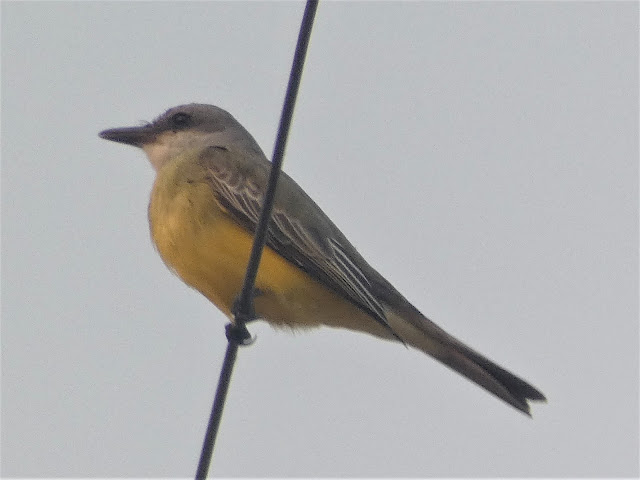
But as I was snapping the  photos, I  realized something was missing. Western Kingbirds usually have a white strip on the flanks of their tail feathers, and this bird didn't have those. So in my intimate knowledge of the local bird possibilities (rolling of eyes allowed here), I thought of a Cassin's Kingbird (Tyrannus vociferans). This would be kind of exciting because although they've been found in other parts of the county (even the MJC campus), they've never been sighted on the Tuolumne River Parkway Trail. So I took more pictures looking for the white-tipped tail feathers that identify the Cassin's. 

They weren't there. So that was kind of quandary, but I have learned that late in the season the birds feathers can become worn with use and the white coloration might not be visible. I reported the sighting on eBird as an out-of-season Western Kingbird and sent the pictures to a few birders for advice, and moved on to other things. It bothered me though that I couldn't nail down the identification.

A few hours later I get an email telling me that I had photographed what is most likely a Tropical Kingbird (Tyrannus melancholicus). This is even more exciting because not only has it never been seen on the Tuolumne River, it's never been seen in the entire county! This is a bird that is native to South and Central America, Mexico, the southernmost tip of Texas, and the southeastern corner of Arizona. Vagrants wander into California every year, but they stay almost entirely along the coastal zone. 

I've been wondering where this bird came from, and it occurs to me that this could be one of the sad effects of the California wildfires. I can imagine birds being driven from their habitats by these terrible and extensive fires, looking for food and water. That's my hypothesis, in any case. 

The only reason it isn't absolutely, positively a Tropical Kingbird is because there is a practically identical bird called the Couch's Kingbird, which has been seen in the state of California only about three times. The only real way to tell them apart is by hearing their song, which is very high-pitched, meaning I couldn't have heard it even if it was singing. Understandably there will be a group of birders on the trail tomorrow hoping for a sight (and a listen). I hope it's still there!


Sunday, January 5, 2020

1st Bird of the Year: Great Horned Owl on the Tuolumne River

I'm starting out with the most crummy pictures I'll post all year, but of course there is a story. I was up before sunrise on New Year's Day to find out what the first bird of the year would be. Last year I was surprised that the first bird was a Cooper's Hawk, and this year, the first bird was even more unusual: a Great Horned Owl (Bubo virginianus). Only I didn't see it, I heard it. As far as bird compilation sites like eBird are concerned, hearing a species counts just as well as a sighting. But not seeing my first bird was a little frustrating, as you might imagine.

Last year, I never saw a single owl on the Tuolumne River Parkway trail. In November I heard a Barn Owl, but never saw it either. A Great Horned Owl tried unsuccessfully to nest in an oak along the trail in 2018. But I hadn't seen any since.

So today, I saw the Great Horned Owl! On only the fifth day of the year. But of course, it wasn't nearby. It was across the river, way up in a tree, and looking the other way. But I got pictures! And that's why these pictures are the worst you'll probably see all year.

Happy birding this year!!

Friday, January 26, 2018

A Somewhat Rare Visitor on the Tuolumne Parkway Trail: Common Goldeneyes

Now just to be clear, I mean "rare" in the sense that they haven't been seen on this stretch of the Tuolumne River where it flows through Waterford. The Common Goldeneye (Bucephala clangula) is certainly a common bird across the country, and has been reported upstream around Modesto and Turlock Lakes, and downstream around Modesto and the San Joaquin River. But in the last ten years at least (according to eBird), it hasn't been reported anywhere in between.
A Wood Duck (left) joined the flock on one day last week
I first saw just one of them swimming in one of the pools at the water treatment plant where I got the only close-up photo (above). That was on January 3. On subsequent walks I saw as many as five at once, but within a week the flock was up to 17 or 18, with a mix of males and females. Another birder (the only other one to mention Goldeneyes) reported six of them on January 10. At least three were still on the river today, but some may have flown off when I arrived in the area.
I couldn't look at the Goldeneyes and not think about the excitement among birders to the north on the Stanislaus River at Knight's Ferry. There has been a flock of Common Goldeneyes there since about Christmastime, and with them has been a Barrow's Goldeneye. That is a species that has only rarely been sighted in our county, as we are situated at the extreme southern edge of their normal range. It has not been reported since the 10th of January, so you can be sure I was watching carefully to see if it decided to fly just a bit further south!
There have been a number of flocks hanging out on my section of the river lately...today there were five Pied-billed Grebes downstream at the west end of the Parkway Trail. A gaggle of about twenty Canada Geese rested briefly near the slough today. And I saw a flock of five ducks, either Goldeneyes or Wood Ducks, taking off near the water treatment plant.

Friday, January 19, 2018

A Lady Hawk on the Tuolumne River Trail! That's a Merlin to You

I had a new surprise today. On Wednesday it was about a flock of Common Goldeneyes and fresh beaver sign, and today it was a sighting of a totally new bird for me. It was a beautiful sunny day after what seemed like weeks or months of gloomy gray weather (I know, it was just a couple of days). But still, the sunshine was nice so I headed down to the river for some exercise and to see who was out and about. I almost immediately saw an American Kestrel who stopped long enough for a couple of pictures (maybe in a near-future post). Being perched on trees right over the trail, it must have thought I was chasing it.

It finally disappeared but then I saw another kestrel-shaped bird, but I realized almost immediately that the coloration was wrong. I started snapping pictures and wondered what it might be. It was too small for a hawk, and so my inexperienced bird brain said "Merlin". Out came the smart phone, and the pictures seemed to confirm it (as always, I'm open to gentle corrections). A search on eBird indicates only one previous sighting on the Tuolumne River Parkway Trail in Waterford (they range all over the west, and have been recorded both upstream and downstream of my favored trail).
The Merlin (Falco columbarius) is a member of the falcon family that ranges across the northern hemisphere, in Europe and North America. They winter in our region and head north during the summer for breeding. They are fast and agile fliers who prey mainly on small songbirds (as can be seen in my pictures). They went into a steep decline during the DDT years, but have recovered very well, although they are listed as uncommon in our county.

The term "Lady Hawk" refers to the use of Merlins by noblewoman in Medieval times to hunt small birds. They are still used by falconers today.

Thursday, December 14, 2017

Great Egret on the Tuolumne River Bluffs

Great Egrets (Ardea alba) are relatively common sights in our region on the floor of California's Great Valley. The pastures and riparian woodlands are ideal habitat for them, but for whatever reason I don't see a great many of them on my Tuolumne River walks. There is occasionally one hanging out on the river just downstream of the west end stairway up the bluffs, and sometimes I see one near the highway bridge. The last few times I've been down to the river, there has been one perched on the telephone pole at Reinway Park. I love their graceful posing, so I snapped shots on two different days, one of them at sunset. I'm presuming it is the same bird.

Monday, December 11, 2017

Female Phainopepla on the Tuolumne River

I've only seen them a few times on the Tuolumne, but it is always a delight to see a Phainopepla (Phainopepla nitens). When you walk a trail every other day or so, you may get familiar with the habits of individual birds, and you find yourself watching particular bushes very carefully. That was the case the other day, although I wasn't specifically looking for the Phainopepla. The native elderberry bush has been a good spot over the last few years for a variety of species who feed off the ripe berries. The Phainopepla usually consumes mistletoe berries, but I've seen both a female and a male in this particular shrub (really almost a tree, it's 12 feet high). I also have seen a male in the nearby cottonwood tree (where there is plenty of mistletoe).

Of course it was late in the day and there was no sunlight so I only got a silhouette in my photos, and I couldn't even tell whether it was a male or female at first. The prominent crest is the giveaway that it was a Phainopepla, but the males are a silky black color while the females are gray. I slowly walked past the bush until I could look back and see the gray color of the female. I used the photo-editing program to extremes to bring out the features of the bird in the picture below. I still couldn't bring out the striking red eye of the bird, but you can see that in some of my earlier posts.

Sunday, December 10, 2017

The Elusive Ruby-crowned Kinglet on the Tuolumne River

When I say "elusive", I don't mean rare. I see Ruby-crowned Kinglets (Regulus calendula) quite often when I hike the Tuolumne River Parkway Trail where the river flows from the Sierra Nevada foothills onto the floor of the Great Valley in Waterford. The elusiveness comes from the difficulty of actually catching the diminutive but very active bird on digital media. These little birds never stop moving. Ever. The moment I get the camera focused, the bird is already in the next bush.

It took me two days to get these two shots. I hiked the river twice in the last two days, and saw these birds (or single bird twice) in bushes about fifty yards from each other. The bird didn't seem too concerned about me, but it was hungry and stayed on the move. I finally got lucky when I started to anticipate where the bird would land next and had the camera focused on that spot. I think the picture above is my best so far (compare to my others here; you be the judge!). The one below was the best from my efforts yesterday.

In case it's not clear (and it isn't in these pictures), there are red/ruby colored feathers on the head of the males. They are usually folded down and not easily visible, except during the breeding season. The birds don't weigh even an ounce, and their eggs are also small...50 of them would add up to a single ounce. There will be up to a dozen eggs in a brood. Mama must be very tired...

Monday, October 16, 2017

Red-shouldered Hawk on the Tuolumne River Parkway Trail

I haven't seen too many Red-shouldered Hawks (Buteo lineatus) of late. The last ones I got pictures of seem to have been in 2015, and the only one on the Tuolumne River Parkway Trail was a juvenile. So, maybe this is the same one, grown up now. I couldn't say. But it was a pleasant surprise to see it perched on the dead cottonwood tree below the water treatment plant.
The Red-shouldered Hawks have a strange distribution. They are common and widespread across the eastern United States and eastern Mexico, and then there is a broad swath across the Midwest, the Rocky Mountains, and Great Basin where they are almost never seen. And then in California, they are common. The separation has produce evolutionary changes, with four distinctive subspecies in the east, and one in the west.
The Red-shouldered Hawks are territorial, and unlike many in the east who migrate with the seasons, they remain in California year-round. That obviously means I need to pay better attention if I want to see this one again.

Monday, March 20, 2017

Wood Ducks on the Tuolumne River Parkway Trail


Well, it's at extreme zoom, and a little bit fuzzy, but darn it I finally got a (semi)clear shot of the Wood Ducks (Aix sponsa) that I know have been lurking about on my section of the Tuolumne River where it flows through Waterford. I was walking the Tuolumne Parkway Trail on the bluffs above the water treatment plant when I saw two large birds in the distance. They looked unusually dark for Mallards, so I zoomed in and saw that it was in fact the Wood Duck pair (the male is the colorful one).

I've seen them at least three times previously, but they've been hiding in the willows or so far away as to be impossible to clearly photograph them. Perhaps next time, we'll get some closer views.

Sunday, January 15, 2017

Spotted Towhees from All Over

Spotted Towhees (Pipilo maculatus) are beautiful colorful birds that I've seen a fair number of times, but I've found them difficult to photograph. Most of the time it is because they are foraging in thick underbrush, and they never seem to sit still. A case in point: I got a nice shot of the Towhee above at Silver Lake near Mt. St. Helens in Washington at Christmastime. But it never turned around to show its colorful breast.
Then, I was at Don Pedro Reservoir on the Tuolumne River to take a look at water levels prior to the big storms of last week (which also explains why no birds for two weeks; I was distracted by events being posted at Geotripper). There was a Towhee in the parking lot foraging for seeds or bugs. I got a shot of the bird's front, and a video as well. But no side shots!

Finally, I was out on the Tuolumne Parkway Trail today for the first time since the storms began, and I saw another Towhee foraging in the open. I got the side shot I wanted, so I was finally able to cobble together this post, from three different locations and with three different birds.

Thursday, May 19, 2016

Ash-throated Flycatcher on the Tuolumne River

I guess I need to do more morning walks along the Tuolumne River. Yesterday's stroll yielded sightings of not one, but three birds new to my Parkway Trail list (up to 45 species now). One the birds was a first for me as well (the Bewick's Wren from yesterday's post). I've seen today's bird, the Ash-throated Flycatcher (Myiarchus cinerascens)  a couple of times, but not on the Tuolumne River (that doesn't mean it's rare, just that I haven't been observant enough to see them). This one stuck around enough for some pictures.

The flycatchers like open woodlands and riparian habitats, which means the Tuolumne is a pretty good place for them. Not surprisingly, they feed on bugs, but will eat fruits once in awhile as well. Like the Bewick's Wren, they are creatures of the American Southwest and Mexico.

I'm trapped in airport limbo for a bit, but I have a chance at some species from the eastern U.S. over the next few days. I'm sure I'll find time to post them if I see them!

Tuesday, May 3, 2016

Northern Rough-winged Swallows on the Tuolumne River Parkway Trail


I took my customary stroll on the Tuolumne River Parkway Trail (still not completed!) this afternoon, and wasn't seeing a lot of bird activity, but the river was running clearer than normal, so I found spot where I could watch the water flowing from about 20 feet above. I finally realized that there were several small birds perched on a willow branch above the water. I zoomed in and got some pictures.

The pair of birds were unfamiliar to me, although their extremely long wings suggested that they were swallows of some sort. My best guess is that they are juvenile Tree Swallows (Tachycineta bicolor), but as always I am pretty new at bird identification and would welcome an expert's judgement here [Postscript: Silver Fox is suggesting Northern Rough-winged Swallow (Stelgidopteryx serripennis), and I find it convincing; see comments].
They would occasionally fly out over the water, but the only quarry I saw them catch was a foxtail seed. Here's a short video; they were very cute.

Monday, February 22, 2016

Away from the River Too Long: Nuttall's Woodpecker on the Tuolumne

A combination of extensive travels and orthopedic problems have kept me away from my own backyard wilderness along the Tuolumne River. It's been a month or more, so I headed down today to see how the spring bloom was progressing.

I saw more than the normal number of birds, including a first time sighting of this one, a Nuttall's Woodpecker (Picoides nuttallii). I've seen them in the area, but not on the river before. Nuttall's Woodpeckers are very nearly one of the few California endemic species, with a range that extends just over the Mexican border (1% of their population lives there), and maybe just a little bit into Oregon. They prefer the oak woodlands that are so prevalent in the state, although they don't eat acorns. They're usually chasing down insects, and occasionally some fruits.

The River Parkway Trail is "nearing completion" as they have been saying for months now, but it is walkable, and spring is beginning. Some of the nut trees are reawakening, and the grass is knee-high. A few flowers are starting to appear here and there. It was a delightful return to strolling along the Tuolumne River.

Tuesday, December 29, 2015

Spotted Towhee on the Tuolumne River Parkway

Spottted Towhees (Pipilo maculatus) are another of those birds that drive me nuts by being hard to photograph. I've seen a fair number of them during my walks along the Tuolumne River near my home, but they are fond of hiding in the underbrush and rarely stick around when I walk by.

The Towhees are one of the largest members of the sparrow family. There is an Eastern Towhee species with a range in (surprise!) the Eastern U.S.that is very similar, but the populations were separated by the vast continental glacier that moved repeatedly into the midwest states during the ice ages. With different climate and habitat, the two groups diverged.
I was walking under a large oak tree along the River Parkway Trail in Waterford when I noticed the buff-colored bird. I thought it was a Robin at first but quickly realized the coloration was wrong. For once the bird remained still while I pulled out the camera and got a few pictures off. They aren't the best shots I could hope for (yet), but sunny days will come. One thing that doesn't come through in today's pictures are the incredible orange-red eyes. So you can appreciate them, I've included a shot from last November when I saw a Towhee creeping through the brush at the Joe Domecq Wilderness on the Tuolumne River.