Showing posts with label Say's Phoebe. Show all posts

Monday, January 13, 2020

The Birds of Del Puerto Canyon - A Place That Could Soon Be Damned

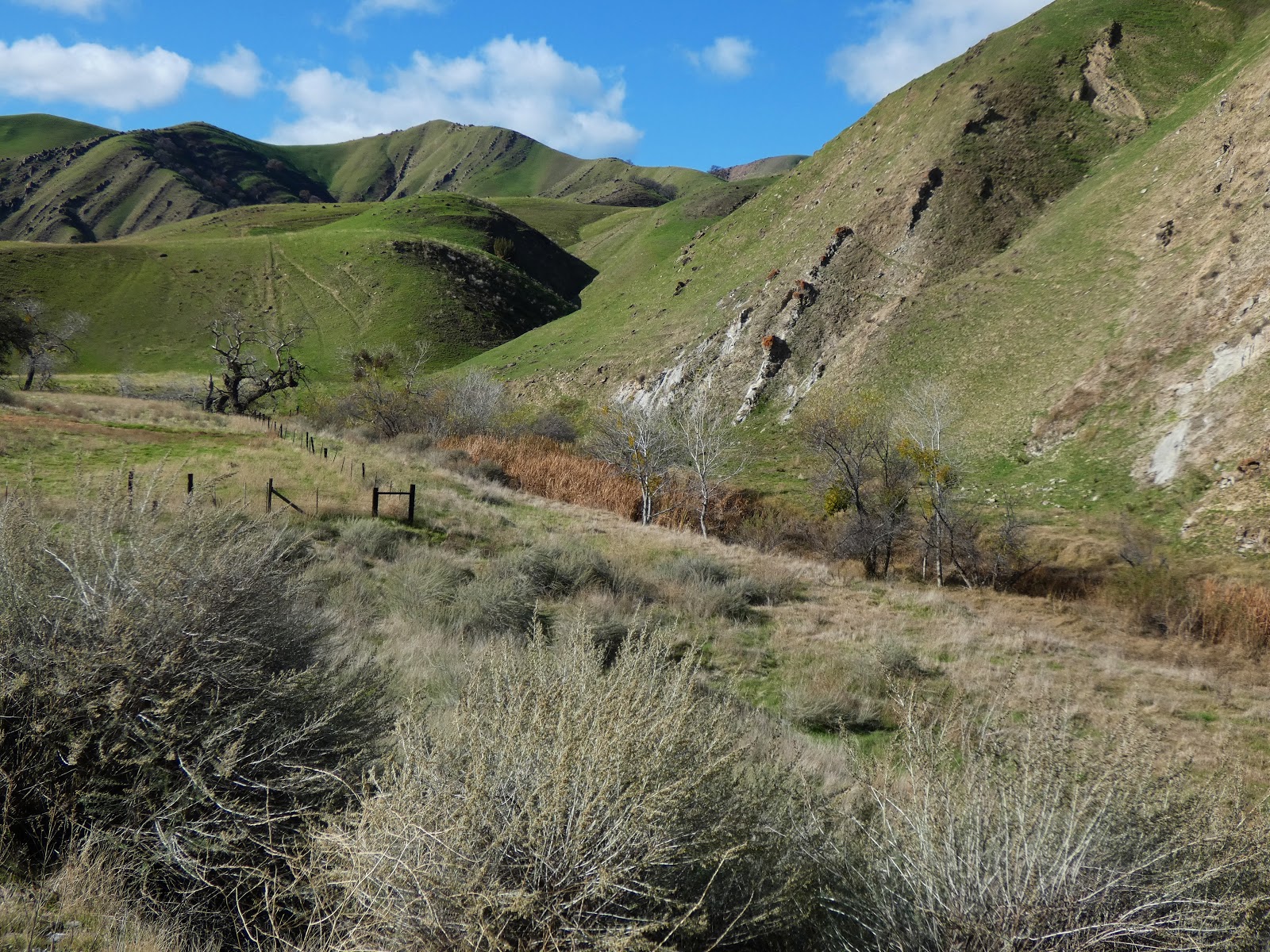
This portion of the canyon would be inundated by the proposed reservoir.

The Diablo Range is one of the principle "sub-ranges" of the California's Coast Ranges, running more than 100 miles from Highway 46 at Polonio Pass to the Sacramento-San Joaquin Delta. There are only a few major highways that cross the range, principally the Altamont Corridor and Pacheco Pass at San Luis Reservoir. There are a handful of state parks that preserve a portion of the range, mainly Henry Coe and Mt. Diablo, but for the most part the lands are privately owned and are given over mainly to grazing and ranching. Only one paved road provides access to the interior of the range north of Pacheco, and that is the winding route of Del Puerto Canyon.
Loggerhead Shrike


Del Puerto is the only public access to the mountain range in Stanislaus County, and as such is one of very few places where anyone can study the unique bird life (and many other animals) in this intriguing place. But now there are plans afoot to eliminate much of that access, and indeed to severely impact the natural environment. There are plans to build a large dam that will inundate five miles of the extraordinarily scenic canyon.
Savannah Sparrow

The canyon is one of the most important bird habitats in Stanislaus County, offering a significant variety of ecosystems, including riparian wetlands, grassland prairies, oak woodland, and a unique serpentine soil-based gray pine habitat. The eBird archives record more than 160 species of birds in the canyon
Killdeer
These pictures, some better, some worse, record two trips in the last year up into the canyon, when I didn't actually have a lot of time for actual birding. They serve to show the wonderful opportunities the canyon has for learning about the fascinating natural history of our region. The proposed dam would have a profound impact on the environment of the lower canyon.
Bullock's Oriole, a summer migrant in the canyon


Black-headed Grosbeak, another summer migrant


Western Tanager


Say's Phoebe in the lower canyon
Northern Harrier in the proposed dam site

Western Kingbird in the lower canyon


There will be many reasons offered as to why this reservoir is SO necessary, and how there will be SO many benefits. But the question needs to be asked, what is this taking away from all of us?

If you are on Facebook, check out https://www.facebook.com/groups/463664377903706/

Read the Environmental Impact Report at this link. If Del Puerto Canyon has significance to you, please respond and be active in the opposition! If you have expertise in any of the areas that will affected, you need to be heard from.

There are several important meetings and deadlines coming up very soon:

1/15 3:30pm Protest. Corner of Ward and Sperry
1/15 4:00pm Public Meeting. Hammon Senior Center 1033 West Las Palmas, Patterson
1/21 6:30pm City Council Meeting. 1 Plaza Circle. - request they take a stand, voice concerns
1/27 5:00pm Public Comments DUE. ahansen@delpuertowd.org OR Anthea Hansen PO Box 1596 Patterson CA 95363
1/28 9:00am Board of Supervisors Meeting 1010 10th St Modesto CA - voice concerns, they have final decision

Friday, October 25, 2019

Say's Phoebe at Modesto Junior College


The college campus where I work is not the best environment to watch birds, but it's certainly not the worst. There is a sheep pasture with a heavily vegetated drainage pond, some open fields grazed by cows and horses, and lots and lots of diverse species of mature trees, both native and non-native. Overall the number of species I've seen there is about half what I've seen along the Tuolumne River Parkway Trail where I do most of my searches.

But there are still some neat species to be seen. One of the pretty little birds I occasionally run across on campus are Say's Phoebes (Sayornis saya). Say's Phoebes are members of the flycatcher family, and their behavior fits their name. They'll perch on a branch, sally forth when they see a bug, and return to their perch. I saw this one while walking between classes yesterday.


Monday, July 9, 2018

Say's Phoebe Babies at the Palm Springs Art Museum


It's kind of interesting that practically that only occupied nests I've seen lately were those of Say's Phoebes (Sayornis saya). I haven't seen any on the home trail yet this year, but I saw several on the Colorado Plateau trip last month, and both were attending to nests. This was also true the previous summer at Pecos National Monument in New Mexico. Then last week I had occasion to be in Southern California, and while touring the sculpture garden at the Palm Springs Art Museum I didn't see the nest, but I saw the recently fledged chicks badgering momma for food.
The birds did not seem overly concerned over our presence. It was a cooler day than normal in Palm Springs, just 103 degrees or so, and perhaps they were more concerned with enjoying the balmy weather.
Say's Phoebes are members of the tyrant flycatcher family. Their name describes them well, as they live almost exclusively on insects. Like the other flycatchers, they like to perch and fly out to capture their prey before returning to their perching spot.
The Say's Phoebes are tropical denizens for much of the year, although many migrate north in the summer for breeding. According to EBird, they range farther north than any other flycatcher. They are resident non-migrating birds in the desert southwest (which by coincidence is where I've seen a lot of them).

Wednesday, January 17, 2018

Say's Phoebe at the Merced National Wildlife Refuge

Here's a bird I haven't posted in awhile. Flycatchers are a challenge to photograph. The Say's Phoebes (Sayornis saya) constantly fly erratically from their perch, chasing down insects, and then land again. If I would ever just learn to just focus on the perch and wait for it to come back, I would do much better. These Phoebes range across western North America, from Central America to the Arctic. This one was hunting at the Merced National Wildlife Refuge last week.

Thursday, September 24, 2015

Say's Phoebe at the San Joaquin National Wildlife Refuge, and a Horrific Weed

Sometimes you only get one shot at a bird. I was really happy with this shot of a Say's Phoebe (Sayornis saya) at the San Joaquin National Wildlife Refuge. I was walking the Pelican Nature Trail in the heat of the afternoon, and there weren't a lot of birds out in the open, and even fewer that wanted to sit still long enough for a photograph. I got just one good shot of this one before it flew off.

It's been a catastrophically dry year in the Great Valley, and the effects were clear at the San Joaquin NWR. The river was barely flowing, and invasive Water Hyacinth plants threatened to cover the river completely. The weed is extremely hard to control, and eradication is probably impossible. For the moment I think there are high hopes for flood runoff to just sweep them out to sea. They've got a "bloat" of hippopotami grazing on hyacinth in part of the river delta near Stockton. I guess they're bringing in some manatees, too.

Postscript: In case there are misunderstandings about the hippos and manatees, check the date of the hippo story...

Friday, August 14, 2015

Say What? Oh, a Say's Phoebe at Pecos National Historical Park

The flycatcher family has to be a favorite with beginning birdwatchers. It probably has to do with their habit of perching over and over on the same post or branch waiting for bug to come by. They swoop out, capture their bug, and perch again. That makes them a lot easier to photograph!
That's what made these Say's Phoebes (Sayornis saya) a little bit unusual. They weren't really chasing bugs. They had already caught their bugs and just seemed to be waiting around. We were at Pecos National Historical Park on our recent field studies trip to New Mexico. They were hanging out around the entry doors for the visitor center for some reason.
Pecos was one of the most important of the New Mexico pueblos hundreds of years ago, standing as it did at a pass between the Great Plains and the Rio Grande River valley. It was a center of trade, and a strategic target. It was even a battlefield during the Civil War. The battle at Glorietta Pass was fought more or less to a draw until the Union forces were able to burn the supply wagons of the Confederate troops. The Southerners were forced to retreat back to Texas, and New Mexico remained under the control of the United States.
In any case, the pair of Phoebes kept lurking by the door, and someone finally pointed out to me the reason.
Doesn't this one seem to be saying "Duh, isn't it obvious?" (but I never anthropomorphize birds...)?
They had a nest on top of the light fixture near the entrance! Once people were inside, the birds would swoop in and feed their very young nestlings (I took this shot from a fair distance away with a zoom, in case you were wondering).

Thursday, November 20, 2014

Bird of the Day: Say's Phoebe on the West Campus

I haven't seen one of these in a few months. I assume they're moving back south after breeding in Arctic regions. It's a Say's Phoebe (Sayornis saya), a little flycatcher that is doing pretty well, because it adapts well to human developments (nesting in and around houses and other buildings).
They may be common, but I've only seen them around the little pond on our west campus, usually in the same places I often see the Black Phoebes.  I'd like to get a few more pictures on a sunny day, as these are just a bit fuzzy in the gloomy gray conditions we had today (but I don't mind the rain! We really need it out west).