Showing posts with label CSU Stanislaus. Show all posts

Wednesday, November 30, 2022

Those Tropical Kingbirds! A Fun Coincidence...

Tropical Kingbird, Florence Oregon, Nov. 2022
In October of 2020 during the height of the Covid epidemic, I was beginning the habit of walking the Tuolumne River Trail in Waterford every day for exercise and birdwatching. I saw many interesting birds, over 120 species that year, but on that day in October, the bird I saw was memorable, although I didn't know it in that moment. What I thought I saw was a Western Kingbird. It was a bird that should have been far away in Central America, being a long-range migrant. It was wildly out of season. So I took pictures to document it, and sent copies to some local birders. I was told immediately that it wasn't a Western Kingbird at all, but that it was instead a Tropical Kingbird (Tyrannus melancholicus), a bird I hadn't even heard of before, as it was a bird more native to Mexico and southern Texas. What's more, it was the first sighting of the species ever in Stanislaus County. So that was all very exciting at the time.

Jumping forward to the present day, I was up north in Oregon, in Florence for Thanksgiving. Although there was little time for intense birding, I kept my camera close by and while walking through Old Town Florence, I saw a bird on the wires above that seemed a bit out of place. It was more yellow than the species I was expecting to see. I snapped the picture above and realized it was a Kingbird. I checked for the tail markings that would have meant Western Kingbird, but they weren't there. Cassin's Kingbirds simply aren't found that far north, and it didn't have those tail markings either. I knew that despite their rarity, some Tropical Kingbirds were known to range pretty far north along the coast. So I checked the eBird records and found that one or two had been seen in the immediate vicinity over the last few weeks. I had found the second Tropical Kingbird I had ever seen!
Tropical Kingbird at CSU Stanislaus, Nov. 2022
I got back to the motel and reported the bird and checked my email. Much to my surprise I found that a Tropical Kingbird had been sighted in Stanislaus County that very day! It was on the campus of CSU Stanislaus, where I teach a couple of courses. It was only the second sighting ever in the county, and it stayed in the area long enough for half a dozen birders to catch a view. Being six hundred miles away, I felt I had little chance of getting a look, but I headed down there today to teach my classes. Wouldn't you know, there it was right outside the Science Building. I got just one lousy shot before it flew off, but I got to see the rare visitor.

An interesting convergence of sightings...
 
The Tropical Kingbird from the Tuolumne River in 2020


Wednesday, October 2, 2019

Black-crowned Night Herons in the Daytime!

Busy days! I've found precious little time to post pictures in the last few weeks with the start of school and a major field studies trip, but things are slowing down just a little bit, and I've had a few quiet moments. I just took a stroll around the CSU Stanislaus campus before a class this evening.
I saw a few first arrivals of the fall migrants, mainly White-crowned Sparrows and Yellow-rumped Warblers, but the attention-getter of the evening was the pair of Black-crowned Night Herons (Nycticorax nycticorax) hanging out on the bridge over Warrior Lake.
I see them often enough, but it is somewhat rare for them to be so available for photographs. I'm glad they were feeling visible today! They are beautiful birds.


Wednesday, May 8, 2019

Ugly-cute, or Cute-ugly? Another Kind of Spring Arrival at CSU Stanislaus

I can't decide if they are cute-ugly, or ugly-cute. In any case, these little technicolor chicks were hanging around Warrior Lake at the campus of CSU Stanislaus. They are among the other "spring arrivals" that I've been blogging about for several weeks now. Only they aren't tropical migrants, they are simply newborn chicks of some of the resident species.
I admit that if Mama hadn't been hanging out nearby, I never would have guessed the species of these little ones. The colors certainly give no hint, but their gangly legs sort of do. Do know their identity?

Ah, there's Ma. They're American Coots (Fulica Americana). Who knew they could be so colorful?

Wednesday, April 3, 2019

Life Sucks Sometimes. Let's Look at Some Baby Ducks.

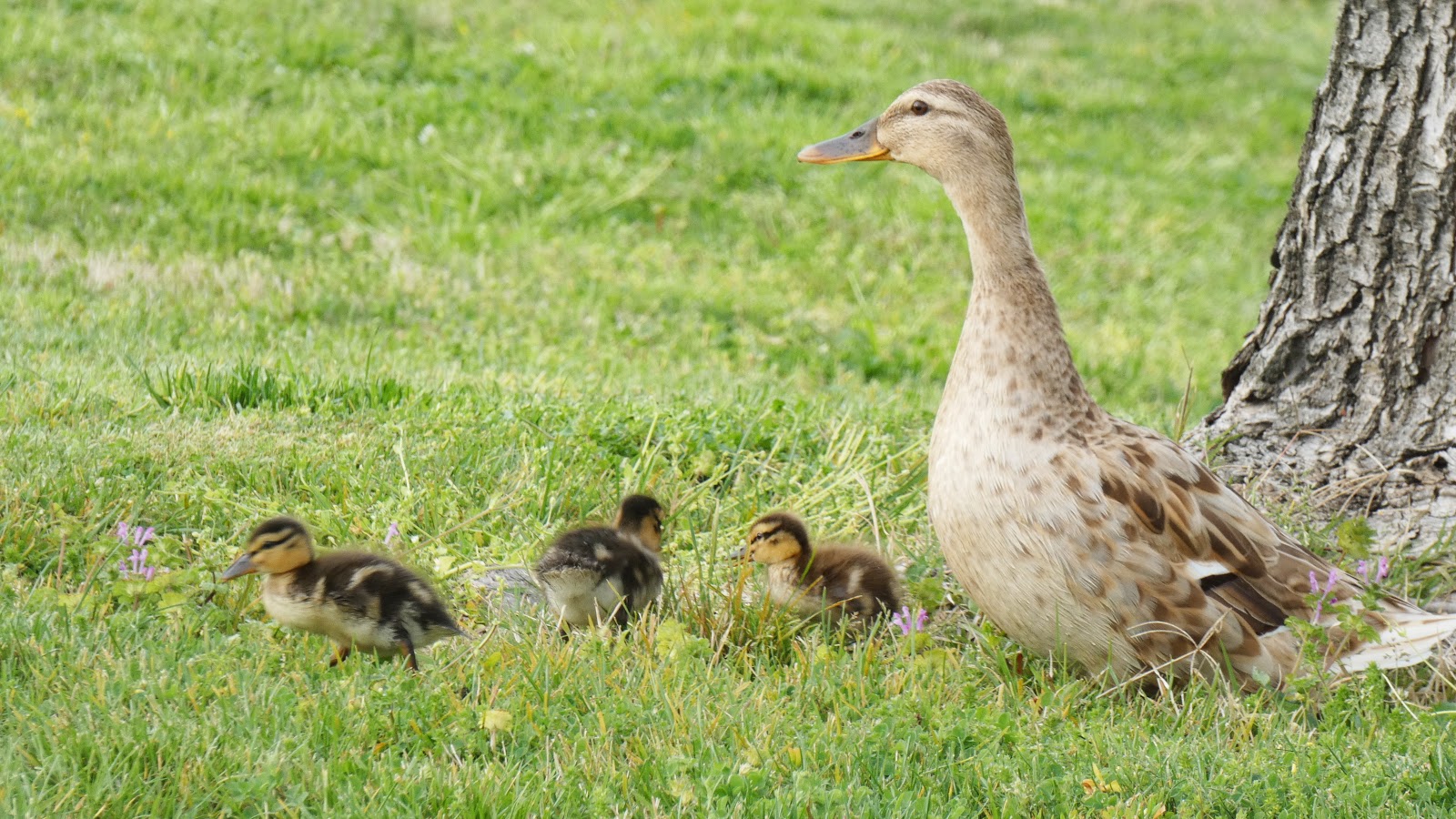
Spring is breaking out all over. At CSU Stanislaus, the Mallards (Anas platyrhynchos) have had their ducklings and eight or so were exploring the lawns near Warrior Lake today.
Momma was doing her stellar job of keeping all her ducks in a row, so to speak. There was one oddity today, and I wonder if other folks have ever seen this happen. A Canada Goose was assisting in the protection of the ducklings! It was following the family and when I approached on the sidewalk, it placed itself between me and the ducklings and made threatening noises.
All I could think of while watching the cute little babies trundling across the lawn was "life sucks", but this made things better for a moment. I made a short video for your enjoyment...

The

Thursday, March 28, 2019

A Long Distance Migrant...Swainson's Hawk at CSU Stanislaus

One of these days, there is something I would really like to see. I would like to stand in the migratory path of the Swainson's Hawk and watch them fly by the thousands on their way to and from Argentina. Their 6,000 mile twice yearly journey is pretty much the longest of any hawk species. In the meantime I'll have to be satisfied with their arrival in the region during the spring. I've several this year, but my photography success has been limited.

The other evening I was wandering around the campus of CSU Stanislaus when a large hawk flew over my head and into the trees up ahead of me. I didn't think I'd be able to see it again, but I saw a hint of gray in the distance, and the zoom confirmed that it was a Swainson's (well, actually Siera Nystrom assisted). I got a couple of shots, and then it took off again and I got a dark silhouette of the bird against the sky. With the help of some intense photoshop work I was able to bring out the wing markings and tail feathers.

Wednesday, March 6, 2019

That Freaky Weird Eye...Double-crested Cormorant at CSU Stanislaus

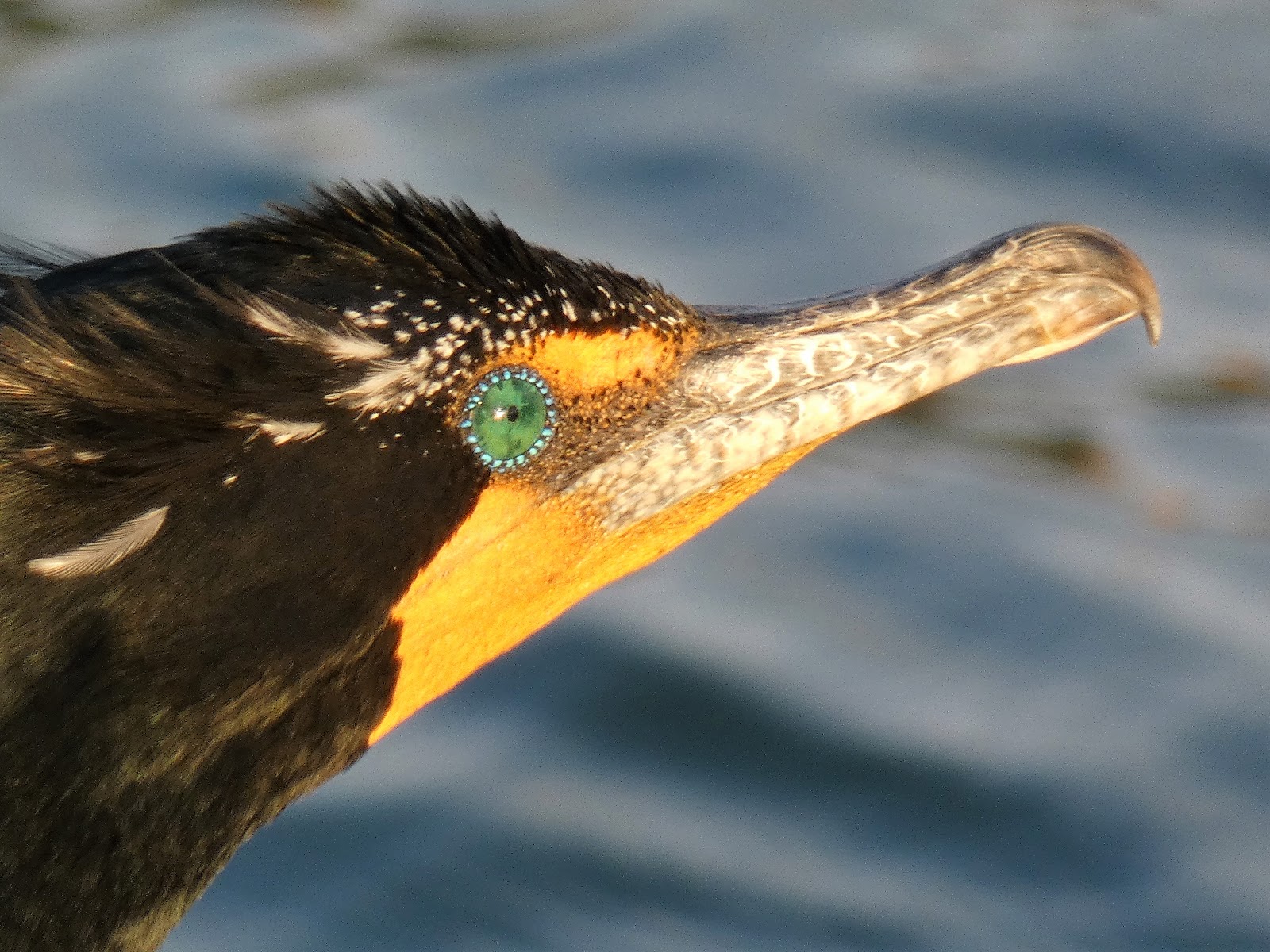
It is one of the most alien-like eyes in nature, in my view. I mean, sure, there's reptilian eyes with their cold emotionless stare, and goat's eyes with their horizontal slits, but nothing can quite compare to turquoise stare of a Double-crested Cormorant. I rarely get near enough to them in the wild to get closeup pictures, but there is one that lives in Warrior Lake at the campus of CSU Stanislaus, where I teach part-time. It is much more acclimated to people and so doesn't retreat as I walk by.
The Double-crested Cormorants, like all their cousins, are consummate fish hunters. Unlike most fishing birds, they dive into the water and chase their prey under the surface. To do so, they can't be overly buoyant and thus they have fewer oils in their feathers. They can get sort of waterlogged, in other words. As a consequence, they will spend a portion of their day drying off, like this one was doing when I happened by.

Wednesday, February 20, 2019

The Gifts of the Day: Black-crowned Night-Herons at CSU Stanislaus


Some days are just gifts, and I can certainly say I've had more than my share. And this was one of those days for kind of a silly reason. I like to count things. It's just a quirk in my personality. I count the students in my classes. I count hits on blog meters. I count the days to pay day. I count all kinds of things. That's why birding was bound to eventually become an avocation (obsession?) for me, once I caught on.

So I record my bird sightings on eBird which has a whole bunch of neat ways to keep track of one's birding adventures. And one of those lists is the yearly tally, the birds one has seen since the first of the year (as opposed to the "life-list"). I've been dutifully keeping track of my bird sightings and the numbers mounted, with 98 birds sighted in the county since New Year's Day. And then I seemed to stall. There was the wonderful sight of the Bald Eagle two weeks ago, but there had been little movement since then. Lots of birds, but not new species. I was stalled at 98 and it bothered me in a "Monk" sort of way. I wanted to get to a nice even 100 and it just wasn't happening.
So I headed over to CSU Stanislaus for my evening course, and I decided to walk a little and see if I could find the rare Sage Thrasher that has been living on the campus the last few months. I found it and got a couple of pictures, but it wasn't bird 99 (I had seen it last month). But then another bird hopped into view and I recognized a Hermit Thrush! It was pretty, and it was bird 99. Now I was on a roll and I decided to search for the Black-crowned Night-Heron (Nycticorax nycticorax) that I knew was living in the reeds of Willow Lake. I couldn't find it but I decided to have a look at Warrior Lake too and there it was! A Black-crowned Night-Heron! And it was staying still. I got a bunch of close-ups from my spot on the bridge.
I was thrilled, but eventually I had to move on. And then from the other side of the bridge, I spotted another! This time it was a juvenile. And it cooperated for pictures too. So in the end, I got to see two of my favorite birds, but I also reached a nice arbitrary number as well, 100 birds so far this year in Stanislaus County.

Saturday, January 26, 2019

Searching for the Sage Thrasher, Our Rare Visitor at CSU Stanislaus


There's a rare bird hanging out in the region (actually several, but this is the one I got to check on today). It's a Sage Thrasher (Oreoscoptes montanus), and it has spent at least six weeks (it was discovered on Dec. 11 by L.D. Scott) living in some elderberry shrubs along the Trans-California Trail on the campus of CSU Stanislaus in Turlock. I got some pictures back in December and looked for it again later, but I wasn't successful until this afternoon. CSU Stanislaus started classes this week and I needed to duplicate my syllabi, but I couldn't help but take Mrs. Geotripper with me to try and find the Thrasher.

It was shy at first. I didn't see it at all in the bush where it's been hanging out so I walked away to find other birds, and when I returned 15 minutes later it was foraging on the ground under the bush. I got one fuzzy picture and it disappeared again. I went to find Mrs. Geotripper and we wandered back and found the bird perched in a different shrub. This time it stayed put so we both got some nice shots.

As the name suggests, the Sage Thrasher prefers habitats more characteristic of the deserts east of the Sierra Nevada. Only a dozen have ever been seen in our county. They thrive on insects and the like but will also consume berries which explains why it chose to live in the elderberry bush at CSU Stanislaus.

Tuesday, January 8, 2019

A Little Cross-species Bathing...Not That There's Anything Wrong With That...


Mind you, I'm as tolerant as they come. I was running errands at CSU Stanislaus today and found that there were puddles all over the place from last night's rather intense storm. I could see in the distance that some birds were joyfully splashing around. As usual I had my camera so I focused in and saw that they were Cedar Waxwings (Bombycilla cedrorum). But something was off...the bird in back was a lot bigger.
A second later the two birds separated and looked my way. And if looks could kill, I would have been in trouble...that Cedar Waxwing was romping in the water with an American Robin (Turdus migratorious)! The scandal of it all!
 Ah, to each their own, I say. I carried on with my errands.

Friday, December 14, 2018

A Truly Rare Sighting at CSU Stanislaus: A Sage Thrasher


The Grackles that I saw on Wednesday were a little bit unusual for this time of year, but today's sighting is truly rare: A Sage Thrasher (Oreoscoptes montanus). This is only the thirteenth sighting of the bird in Stanislaus County ever according to eBird, and is only one of four seen in Northern California in the last month.

I certainly can't take credit for finding it. Another birder, L.D. Scott, saw it for the first time on the Dec. 6 and identified it. He showed me where to look on Wednesday (an elderberry bush along Monte Vista Avenue on the "Trans-California Trail"), but I didn't see it until today when I had a last pre-Christmas errand on campus. I saw L.D. and several others gathered in front of the elderberry, and I joined them in getting photographs.

As the name implies, the Sage Thrasher is more a denizen of the Intermontane West, the high sagebrush prairie that extends across the Basin and Range Province of Nevada and Utah. It migrates as far north as the Canadian border and winters in the southern part of Arizona, New Mexico and Texas as well as northern Mexico. I've seen them once before, but in a more normal habitat in the sagebrush flats around Mono Lake. It was a privilege to have one pop up in my local neighborhood.

Thursday, December 13, 2018

An Odd Late Season Sighting: Great-tailed Grackles at CSU Stanislaus


I haven't seen too many birds at CSU Stanislaus of late. Ever since Daylight Savings, I've been arriving on campus after dark, which is good for seeing the Black-crowned Night Heron in Willow Lake, but not much else. It is finals week, so I arrived a few minutes before sunset yesterday to get the exams ready and I decided to take a quick stroll. I noticed a pair of blackbirds that seemed larger than expected. I then saw how they were holding their heads (beak pointed towards the sky) and realized they must be Great-tailed Grackles (Quiscalus mexicanus).

In a world where most birds are under severe stress from habitat loss and other problems, the Grackles are thriving. They've "invaded" much of the United States from the south (they were originally a tropical species), but they aren't invasive in the usual sense of the word (they are not an unnaturally introduced species like the Starlings or European Sparrows). They do well in human habitats, and the warming climate allows them to thrive at higher latitudes. They've spread naturally.

Still, it was a bit odd to see them yesterday. They usually arrive in the spring and hang out during the summer months and then disappear again, but these two apparently like the accommodations at the University and have lingered into the colder months.

Thursday, November 1, 2018

A Surprise at CSU Stanislaus: A Red-breasted Sapsucker


A few weeks ago I was in Yosemite Valley and saw a Red-breasted Sapsucker, and was properly thrilled to get a couple of half-decent shots. Since I've only seen them in the mountains, I wasn't thinking about them as I walked this afternoon on the campus of CSU Stanislaus. It's an urban campus of course, but there are two "sort-of" natural areas, a pond called Willow Lake that is heavily grown with cattails and tule reeds on one side. The other is the Trans-California Pathway, a kind of reconstruction of the native vegetation from the Sierra foothills to the valley. I was walking through the oak grove at the west end of the pathway thinking how I had not seen any woodpeckers in a long while.

And then I saw one!

I assumed it was the 'usual' Nuttall's Woodpecker or Acorn Woodpecker, but when I focused in I saw the red head and immediately realized it was something unexpected: a Red-breasted Sapsucker (Sphyrapicus ruber). They've certainly been seen in the area (especially by fellow nature-blogger Siera Nystrom), but not all that often. It was a nice little surprise for the day.

Wednesday, September 19, 2018

How to Tell a Great Egret from a Snowy Egret (and others)

If you have trouble distinguishing between heron species, you are not alone! It helps though, if two of the species happen to be foraging next to each other. That happened today at Willow Lake on the campus of CSU Stanislaus. The Snowy Egret (Egretta thula) and Great Egret (Ardea alba) are similar in shape and coloration, but the details are definitely different. The Great Egret is larger, has a yellow bill, and black legs and feet. The Snowy Egret is smaller, has a black bill, has green legs and yellow feet. Cattle Egrets (the picture below is from Honolulu in Hawaii) are also white, but combine a yellow bill with yellow legs, and in breeding season, they have some buff-colored feathers on their head and back. The Great and Snowy Egrets are native to North America. The Cattle Egret (Bubulcus ibis) arrived in the Americas in the late 1800s and spread to North America in the late 1940s. They are common now all the way north into Canada.

Also, as can be seen below, Great Egrets get the joke quicker than a Snowy Egret!

Tuesday, May 29, 2018

Black-crowned Night-Heron at CSU Stanislaus


It's was time for final exams at CSU last week, but I arrived early enough to stroll around the campus to see what birds were out and about. Stanislaus is not a bad spot for seeing birds. There are lots of trees and ponds for habitat, so I tend to see a fair variety as I walk about.
Most of the ponds are carefully tended and the reeds are cut back to keep things "manicured", but Willow Lake lies between the two science complexes and adjacent to the outdoor laboratory area, so it is more overgrown and wild than the other water bodies (I'm pretty sure that's on purpose). It usually has the best variety of water birds and shore birds. There are always some Mallards around, a few American Coots, and some loud and obnoxious Canada Geese. In spring and summer there are Great-tailed Grackles to add to the cacophony. A Snowy Egret usually fishes quietly along the shore.
But until that night of finals, I had never seen an adult Black-crowned Night-Heron (Nycticorax nycticorax). I've seen the Hawaiian sub-species, and I saw a juvenile once in 2016, but never a grown individual. It was in the weeds at the south end of the pond.
It seemed unconcerned about my presence (I was on the walkway along with dozens of other people). The pictures seem close, but that was the zoom-lens at work. The Night-Herons are common enough but are rarely seen because they usually forage at, well, night. They lay low during the daytime hours. Luckily I was out at sunset.

Wednesday, May 2, 2018

Some More Spring Arrivals, But These Aren't Migrants: The Babies of CSU Stanislaus


The babies are everywhere! I took the occasion to wander the campus of CSU Stanislaus in Turlock this afternoon. The landscape includes some rather large ponds, and an artificial stream that is meant to reflect the vegetation from the Sierra Nevada to the floor of the Great Valley. Reeds have become established in some of the ponds, and as such, the campus has recreated some of the wetland environments that used to exist in valley. The birds have responded, and a number of species are reproducing and raising their young on the campus. And that means for a few weeks of the year, there are adorable young chicks running around everywhere.

First we have the Mallard babies (Anas platyrhynchos). Five of them were huddled just a few inches from the pathway along the artificial stream. Apparently the humans here treat them well because Momma Mallard let me carefully step by without scattering as long as I had my back to them and pretended to be looking at something else.
Then there were the Canada Geese babies (Branta candensis). There are a lot of geese on the campus, and at times they have become a bit of a nuisance. They sometimes get chased off by specially trained dogs, but there were around thirty of them scattered across the campus today. There were two broods of goslings that I ran across, and the parents were on the verge of being aggressive when I walked by, but they kept their distance. The babies of course were cute.
The biggest surprise was one that I didn't recognize right away because it seemed like there were no parents around. I got two clues a short time later, as an American Coot (Fulica Americana) was nearby chasing off some Mallards from the baby. And then there were the feet, visible when it climbed out of the water for a moment. Those giant odd-shaped feet are unmistakeably coot-like.


Wednesday, April 11, 2018

Mallard Duck Family at CSU Stanislaus

It turned into "Duck Week" here at Geotripper, and as I got to the end of the list of the more rarely seen species, I realized that in four years I had never posted on the most common duck of all. We have a truism in geology that you could spend a field season in a place collecting all the rare and unusual rocks and minerals, and somehow never pick up the single most common rock in the area. Apparently I do that with birds, too.
In any case, I wondered how to do something original with a duck that is seen at virtually every park and pond in North America, the Mallard (Anas platyrhynchos) I was going through the small handful of pictures that I've ever taken of them, finding little to work with. Then the answer became as obvious as the nose on my face, in the sense that I looked up and beyond the end of my nose, there was a Mallard family walking right outside my office at CSU Stanislaus. I got up and snapped a few shots of the insufferably cute chicks, and that was that.