Showing posts with label Loggerhead Shrike. Show all posts

Saturday, December 19, 2020

Up Close and Personal with a Loggerhead Shrike

The Loggerhead Shrike (Lanius ludovicianus) is an interesting bird. It is most closely related to songbirds, but in life is more like a small raptor, consuming a diet of large insects, amphibians, reptiles, mammals, and even some smaller bird species. They prefer open grasslands with occasional trees or fences to perch and hunt from. I have yet to see one along the Tuolumne River Trail, but we see them fairly often at our local wildlife refuges. I've photographed them many times, but never quite this close.
We were on the Waterfowl Auto-tour at the San Luis National Wildlife Refuge south of Turlock yesterday, avoiding all manner of human contact, but seeing lots of birds. The Shrike is often one of the first we encounter, with the fencing of the Tule Elk compound being a favored spot for the bird. Yesterday was no exception, but unlike past experiences this one didn't retreat when we stopped and rolled down the windows. These are the closest pictures I've ever achieved.


Monday, January 13, 2020

The Birds of Del Puerto Canyon - A Place That Could Soon Be Damned

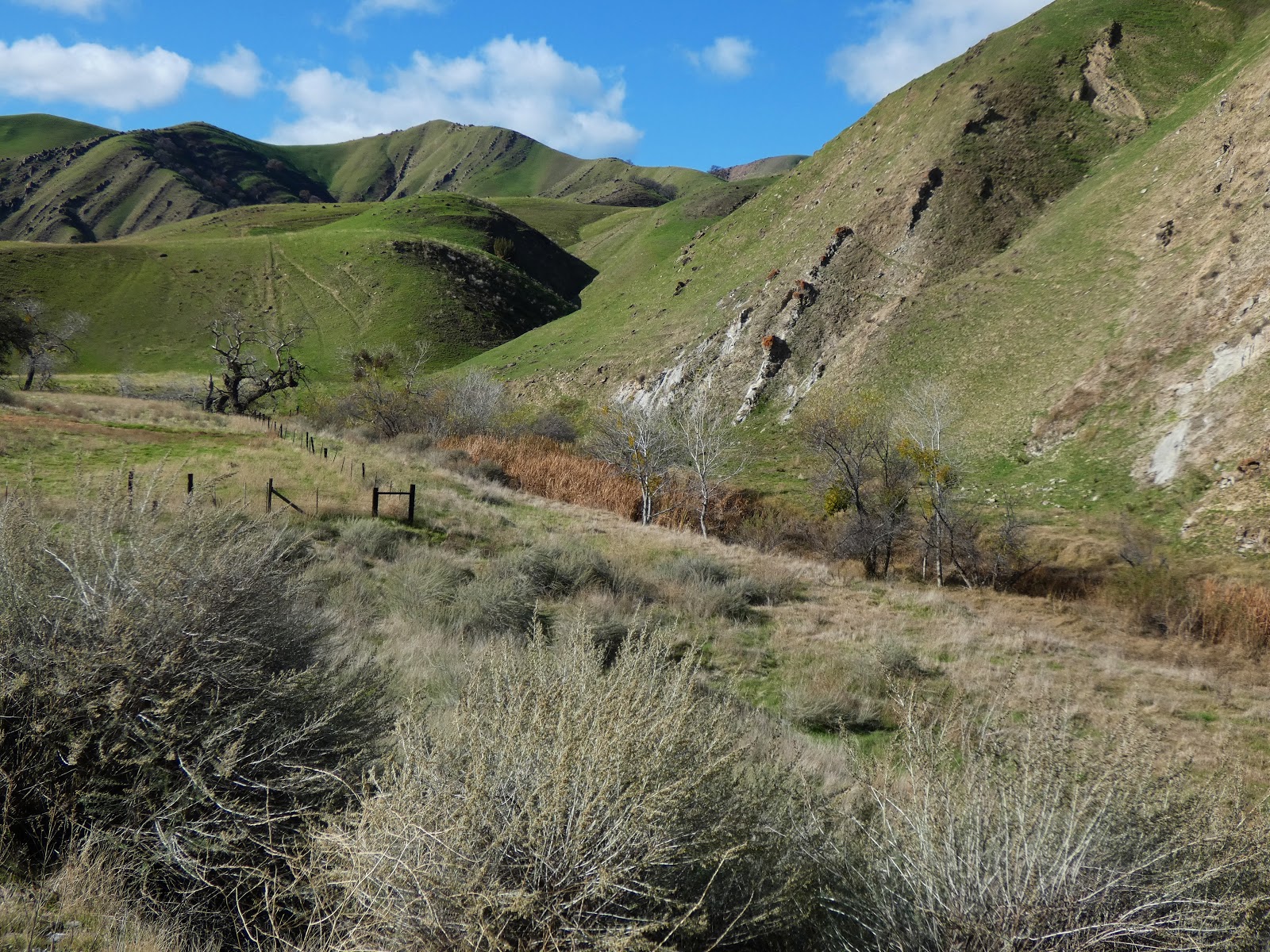
This portion of the canyon would be inundated by the proposed reservoir.

The Diablo Range is one of the principle "sub-ranges" of the California's Coast Ranges, running more than 100 miles from Highway 46 at Polonio Pass to the Sacramento-San Joaquin Delta. There are only a few major highways that cross the range, principally the Altamont Corridor and Pacheco Pass at San Luis Reservoir. There are a handful of state parks that preserve a portion of the range, mainly Henry Coe and Mt. Diablo, but for the most part the lands are privately owned and are given over mainly to grazing and ranching. Only one paved road provides access to the interior of the range north of Pacheco, and that is the winding route of Del Puerto Canyon.
Loggerhead Shrike


Del Puerto is the only public access to the mountain range in Stanislaus County, and as such is one of very few places where anyone can study the unique bird life (and many other animals) in this intriguing place. But now there are plans afoot to eliminate much of that access, and indeed to severely impact the natural environment. There are plans to build a large dam that will inundate five miles of the extraordinarily scenic canyon.
Savannah Sparrow

The canyon is one of the most important bird habitats in Stanislaus County, offering a significant variety of ecosystems, including riparian wetlands, grassland prairies, oak woodland, and a unique serpentine soil-based gray pine habitat. The eBird archives record more than 160 species of birds in the canyon
Killdeer
These pictures, some better, some worse, record two trips in the last year up into the canyon, when I didn't actually have a lot of time for actual birding. They serve to show the wonderful opportunities the canyon has for learning about the fascinating natural history of our region. The proposed dam would have a profound impact on the environment of the lower canyon.
Bullock's Oriole, a summer migrant in the canyon


Black-headed Grosbeak, another summer migrant


Western Tanager


Say's Phoebe in the lower canyon
Northern Harrier in the proposed dam site

Western Kingbird in the lower canyon


There will be many reasons offered as to why this reservoir is SO necessary, and how there will be SO many benefits. But the question needs to be asked, what is this taking away from all of us?

If you are on Facebook, check out https://www.facebook.com/groups/463664377903706/

Read the Environmental Impact Report at this link. If Del Puerto Canyon has significance to you, please respond and be active in the opposition! If you have expertise in any of the areas that will affected, you need to be heard from.

There are several important meetings and deadlines coming up very soon:

1/15 3:30pm Protest. Corner of Ward and Sperry
1/15 4:00pm Public Meeting. Hammon Senior Center 1033 West Las Palmas, Patterson
1/21 6:30pm City Council Meeting. 1 Plaza Circle. - request they take a stand, voice concerns
1/27 5:00pm Public Comments DUE. ahansen@delpuertowd.org OR Anthea Hansen PO Box 1596 Patterson CA 95363
1/28 9:00am Board of Supervisors Meeting 1010 10th St Modesto CA - voice concerns, they have final decision

Sunday, March 19, 2017

Loggerhead Shrike Hunting at the Merced National Wildlife Refuge

They're not uncommon, but it's rare for me to get close enough to a Loggerhead Shrike (Lanius ludovicianus) for pictures (just twice, so far). I was at the Merced National Wildlife Refuge last week, and though the big and charismatic cranes, swans, and geese were there, they stayed far from the auto-tour road. We found ourselves concentrating on the smaller birds, most of whom are year-round residents. They included the owl chicks we saw, and this Shrike that was keeping an eye on things near the viewing platform at the entrance to refuge.

As I've mentioned in past blog posts, the Loggerhead Shrike is related to the songbirds, but behaves like a small raptor, eating large bugs, amphibians, small reptiles and mammals, and even other small birds. According to the Cornell Ornithology site, their population has been in a steep decline, perhaps due to ingestion of pesticides in their prey.

Wednesday, October 5, 2016

Loggerhead Shrike at the San Luis National Wildlife Refuge

While we were driving past the Tule Elk enclosure at the San Luis National Wildlife Refuge last weekend, a Loggerhead Shrike (Lanius ludovicianus) landed on the nearby fence to see what we were up to. I don't see them that often, and it is rare for me to get any decent shots of any (there was this one time last year, though).

The Loggerhead Shrike is related to the songbirds, but behaves like a small raptor, eating large bugs, amphibians, small reptiles and mammals, and even other small birds. According to the Cornell Ornithology site, their population has been in a steep decline, perhaps due to ingestion of pesticides in their prey.

Monday, March 9, 2015

Loggerhead Shrike at the Merced National Wildlife Refuge

We headed out to the Merced National Wildlife Refuge for what we thought would be a final bon voyage to the Snow and Ross's Geese before they head back north to their Arctic breeding grounds. We did in fact see hundreds, maybe thousands of white geese taking flight in the evening, and they did not return while we were there. On the other hand we saw a great many beautiful birds of other kinds. It was a nice day.

The greatest thrill of the day for me was the sight that met me as we pulled up in the parking area at the far end of the auto loop. A pair of gray birds flitted past, and one of them was clearly a mockingbird. The other seemed similar yet different. It landed right in front of me, and I recognized it as a Loggerhead Shrike (Lanius ludovicianus). I got a pair of shots before it took off again.
It's not that it is a truly rare bird or anything like that, but it's only the second time I've seen one with camera in hand, and last time the picture was very fuzzy. The Loggerhead Shrike is related to the songbirds, but behaves like a small raptor, eating large bugs, amphibians, small reptiles and mammals, and even other small birds. According to the Cornell Ornithology site, their population has been in a steep decline, perhaps due to ingestion of pesticides in their prey. I felt lucky to have one so close yesterday.