Showing posts with label Tuolumne River. Show all posts

Sunday, July 23, 2023

Birding With Hearing Loss and my Blue Grosbeak

Hearing deficiency is a pernicious impediment to someone who wants to be a productive birder. As most any birder will tell you, it is often the bird's song that is the first clue to finding and identifying a species, as most birds have good reasons to remain hidden in forest foliage and other habitats. Bird songs are also one of the most beautiful aspects to appreciating the environment that one is living in. 

I've apparently lived all my life with a certain amount of hearing loss, especially at higher frequencies. I realized in my twenties that I could hear crickets in one ear but not the other. I suspect that hearing loss had other effects on my learning abilities, as I could not process words and language quickly and would quickly lose the thread of conversations and lectures if they were not accompanied by visual cues like subtitles (or more recently PowerPoint slides). I was hopeless at learning foreign languages, and I suspect the hearing disability was partly at fault (laziness may have been the other).

But birdwatching captured me. It started for geological reasons actually, when I was exploring the Hawaiian Islands. There are the volcanoes of course, but the stories of the native birds of Hawaii and their unique evolution caught my attention in a big way, and I started looking for the native birds with greater and greater interest. As a consequence, I began paying more attention to my unexpectedly diverse local species, and with the purchase of a camera with a high zoom, I was hooked.

It was frustrating at times. If I was birding with others, they would perhaps stop and say "there's a Downy Woodpecker singing", and I was clueless. I could hear many common birds, but hearing and identifying the rarer and more unusual birds was to me as incomprehensible as trying to listen to a conversation in Spanish or German.

Two things happened. The first was that after living for decades with undiagnosed hearing loss, I was tested and then fitted with some sophisticated hearing aids. As any audiologist will tell you, they don't entirely solve the problem of hearing loss, but they can help. Not by being louder, but by filtering out some extraneous noise so one can follow speech in noisy environments. It turns out that works well when trying to discern bird calls from the ambient sounds of the forest. My aural experience in natural settings was transformed.

The second was Cornell University's Merlin Sound ID app. I've been recording and reporting my bird observations on eBird for several years now, but didn't do much with the bird sound identifier. When I started hearing more bird species I came to realize that the sound app could be a great complement to a person with hearing loss. I cannot count the times that I left the bird app running while I walked a trail, and noticed that some interesting bird species were being recorded. I knew to start looking for them, even though I had not heard them for myself. I've been able to find and report new bird species as a result.

In June, I was using the Merlin app while listening for forest birds deep within Jedediah Smith Redwoods State Park in northernmost California. The app was listing the expected birds like robins and other thrushes, but then it started listing a Marbled Murrelet (Brachyramphus marmoratus) repeatedly. It made no sense to me, since my limited knowledge placed murrelets as shorebirds and we were miles inland. I was curious enough to look it up to find that the bird spends the day fishing along the coast, but then flies inland, sometimes many miles, to their nests in old-growth coastal forests. Their nests were not discovered by ornithologists until 1974!

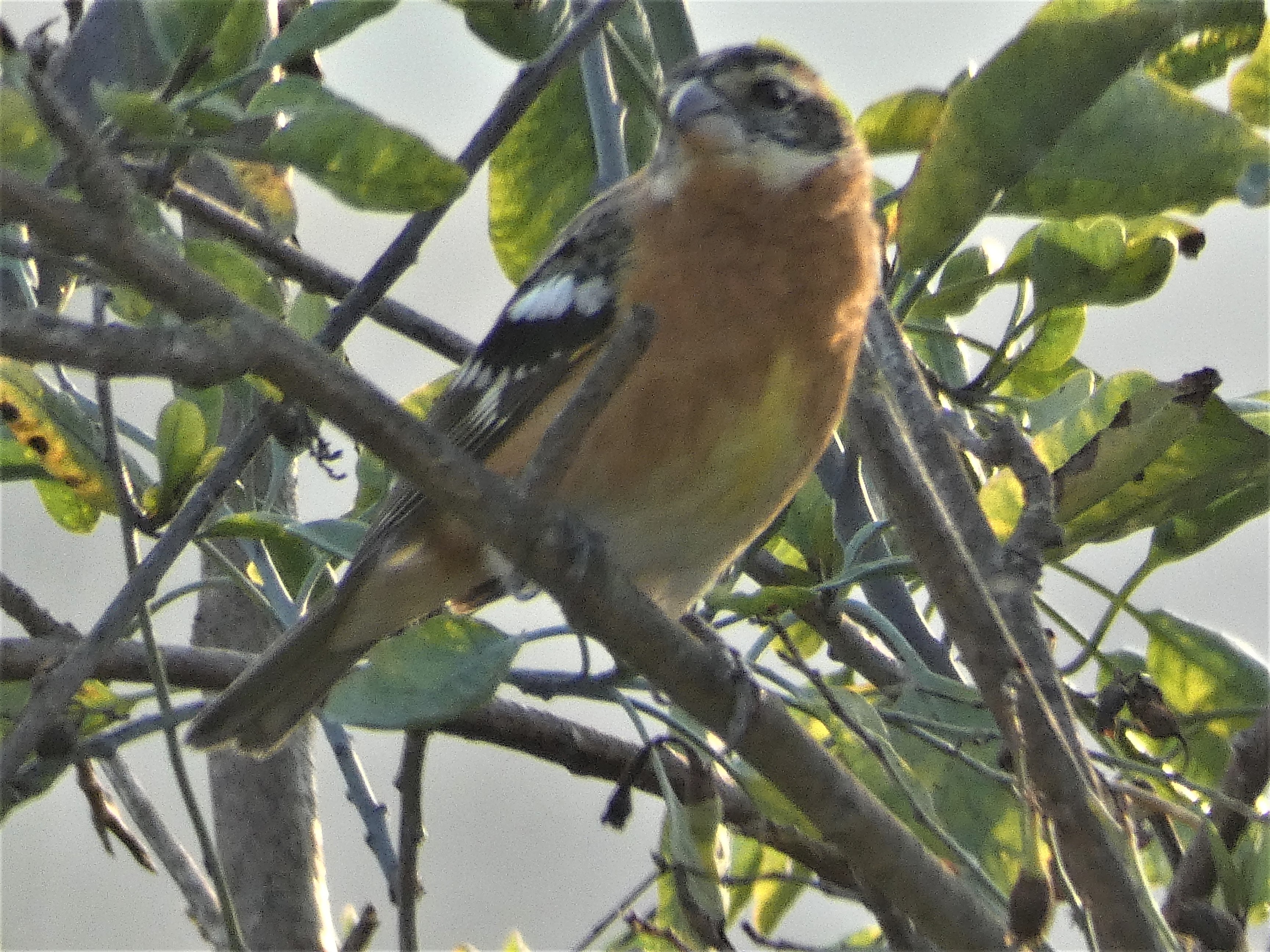
That brings us to our bird of the day, the Blue Grosbeak (Passerina caerulea). The Merlin app is of course not perfect, and may produce inaccurate results (I got a Northern Cardinal on the list the other day even though one has never been seen in the area). I have a personal rule that if the app gives me three repeated identifications of the same bird, I will start looking for it in earnest. And that is how I found the Blue Grosbeak on the Tuolumne River Parkway. It's only my third sighting this year of the species, and only the second on the Tuolumne, so it was a real thrill to capture its beauty on camera.
If there is a moral to this, it may be that if you have hearing loss, it can make a big difference in your life to have it checked. You may be missing far more than you realize.
 

Monday, September 26, 2022

Lewis's Woodpeckers on the Tuolumne Parkway Trail

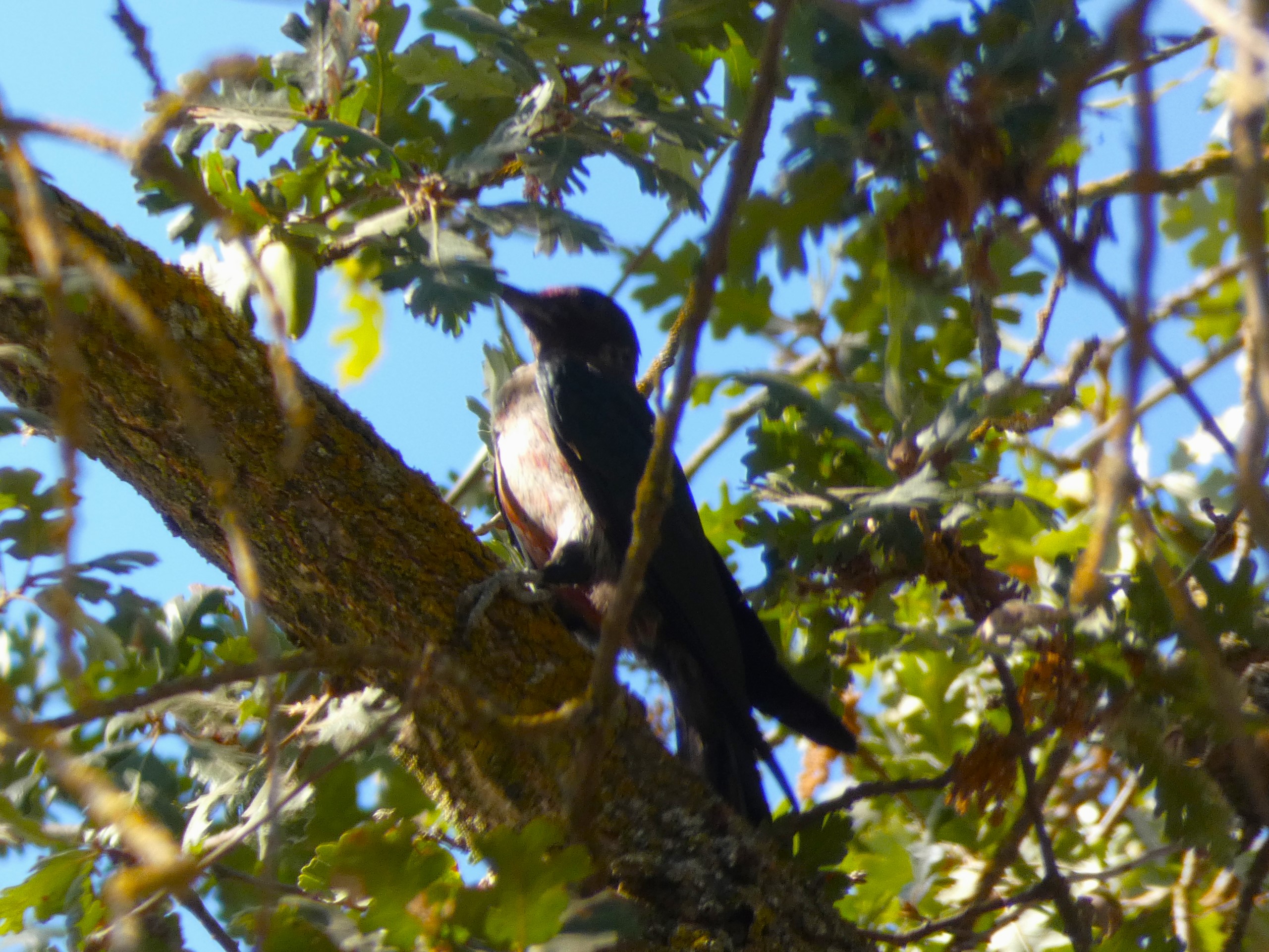
I had a real surprise on the Tuolumne River Parkway Trail the other day. Several birders (myself and fellow blogger Siera Nystrom) were lucky enough to see the first Lewis's Woodpeckers (Melanerpes lewis) ever reported on the trail. The Lewis's Woodpecker is more a denizen of the foothills and mountain environments, and are rarely seen on the floor of the Great Valley. It's possible they were following the river corridor downstream to better food sources.
For being called 'woodpeckers', they don't seem to peck wood all that much, since they mostly eat insects that they catch on the fly, or nuts. They usually nest in hollows carved out by other woodpeckers. And their color scheme isn't all that woodpeckerish either, They have a dark green back and of all things, a pink breast. But they are interesting to see, especially when they are traveling out of their normal habitat.

Of course, when you see a new bird, you'll be fumbling with your camera to try to document its presence, and indeed that was the case with me. They were constantly moving and I only got a couple of fuzzy images, but at least you can see the odd color scheme. I sensed this small flock was on the move, but if I see them again, I'll try to get a few nicer shots and add them in!

Saturday, April 30, 2022

Killdeer Babies on the Tuolumne River!

The pictures are not as clear as I would like, but you can see them! The Killdeer chicks were born this week!
It's always a bit scary for the Killdeer mama (Charadrius vociferus). They love setting their nests on rocky open ground, and the only such ground locally is around the concrete margins of the Waterford sewage treatment facility. The gravelly surface is traversed constantly by maintenance trucks. I do know however that the employees are careful when they know a nest is present, as they will put a pylon out nearby to warn drivers. But there was no evidence that they had detected this nest, so I just worried for weeks as mama tended to the eggs.

Having nests out in the open like the Killdeer prefers is also perilous because of the threat of all manner of predators. There are cats, foxes, otters, and rats in the area, as well as kestrels and ravens. The Killdeer eggs are well camouflaged among the stones, and the bird is famous for its broken-wing strategy of distracting predators away from the nest.

Still, I was distressed to see that the nest seemed to be abandoned in the last few days, and I worried, but today I saw the almost comically small killdeer chicks running around after their mother.


Thursday, April 7, 2022

Finding that First "Special" Bird: Bullock's Oriole on the Tuolumne River

I've thought a lot about the fact that I have become "that guy" on the Tuolumne River Parkway Trail. People can see me from a long way off, the guy in the silly-looking hat who always has binoculars and camera dangling off his shoulders, who can't walk in a straight line because his attention is always directed off to the side or above, essentially anywhere but the trail in front of him.
I have these conversations, sometimes imagined, sometimes real, where I feel just a little defensive and want to say "I'm not really a crazy birder, I'm just getting my regular exercise and I don't want to miss it if a really interesting bird or other animal shows up". But I actually am a crazy birder. But doing the same ritual practically everyday of walking at least two miles and counting birds along the way is not really that strange. Compare the strangeness of doing that with running on a treadmill in a gym every day. You run on top of the moving machine, and no scenery goes by. You maybe have a television on the side of the room to stare at, or you have earphones blaring music. To me that's pretty boring.
How cool is it that every single walk has the potential of becoming something wonderful? Like the dad said in Christmas Story, referring to his yet unopened grand prize, "Why there could be anything in there!" Sure, there are birds that one sees every single day throughout the year, the scrub jays, the doves, the mockingbirds, the starlings. But there are almost always little surprises, the birds you see only once in awhile: Spotted Towhees, Nuttall's Woodpeckers, Belted Kingfishers, or Cooper's Hawks. They add that little bit of spice that turns a mundane walk into an interesting one.

But then there are the migrants. They can only be seen during part of the year, some only during the winter, others in the spring and summer. New seasons bring the promise of that "first of season" sighting, the excitement of seeing a beautiful and spectacular bird after an absence of many many months. It's a neat moment that sometimes takes my breath away. It happened yesterday when I saw the first Bullock's Oriole (Icterus bullockii) of the new year. The bird is not totally rare, and I will probably see a few dozen of them over the next few months, but that first moment you realize what you are seeing is just plain special. Especially when they hang out long enough to get pictures.

There are many more such moments coming over the next few months and one never knows what day it will happen. There will be the first Hooded Oriole, Lazuli Bunting, Black-headed Grosbeak, Green Heron, Olive-sided Flycatcher, Phainopepla, Rufous Hummingbird, and about twenty others before the end of the year. Every single day is a potential adventure. 

Left unsaid of course is the even rarer potential of seeing a bird that you have never seen before, or one that no one in the county or state has ever seen. Climate change has resulted in some species ranging farther north than ever before, so the day may come when I will see something really special, like a Vermilion Flycatcher or Summer Tanager on the Tuolumne River. And that, my friends, is why I am "that guy" out there walking every day looking to the sky, instead of tromping on a machine at the gym.
 

Tuesday, March 8, 2022

A Merlin on the Tuolumne River, for the Second Time This Year

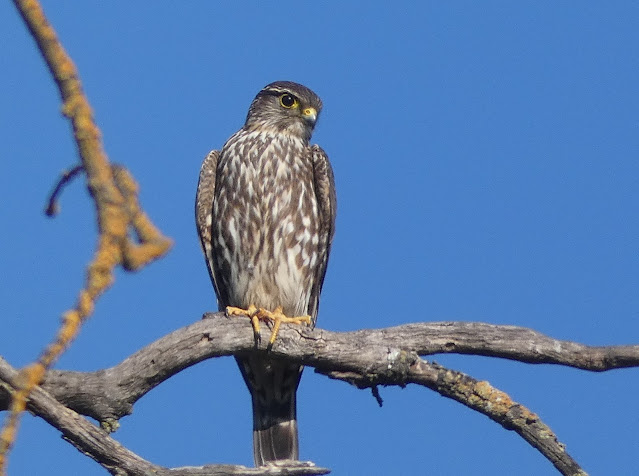
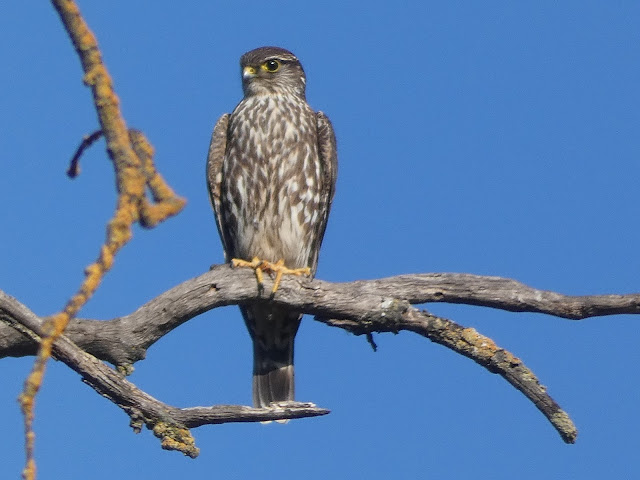
I didn't post about this back in January for plenty of reasons, too busy with school starting, and lousy pictures, but Merlins (Falco columbarious) have been visiting the Tuolumne River Parkway Trail this year. I saw one on January 6 which was gloomy and dark and not conducive for picture-taking, but the only other time was way back in 2018. But today was perfect weather, and the Merlin was cooperating by perching out in the open where I could get a few decent pictures.


Merlins are the 'Lady Hawks' of Medieval times, but they are actually falcons, and like other falcon species, they have been used by falconers for years for hunting and hobby purposes. They underwent a severe decline because of the use of DDT in the fifties and sixties, but they have recovered nicely since the pesticide was outlawed. 

It was a pleasant surprise to see one today.

Thursday, March 3, 2022

New Bird on the Tuolumne River Trail! A Peregrine Falcon

It's always such a great moment when one sees a bird for the first time, or sees one the "home turf" for the first time. I had one of those marvelous moments today during my customary walk on the Tuolumne River Parkway Trail. There is a long-dead Cottonwood snag on the western part of the trail that is kind of a roadhouse inn for many kinds of birds. The high branches provide a wide-ranging view of the surrounding terrain so on a given day I might see American Kestrels, Ospreys, Red-tailed Hawks, Turkey Vultures, and on less common occasions, Red-shouldered Hawks and Merlins. The tree is also the nighttime roost for several dozen European Starlings, and home for a family of at least five Acorn Woodpeckers.
I was a bit pressed for time, and conditions were overcast and gloomy, so I wasn't expecting to see all that much, but as I approached the snag, I saw a bird larger than a starling but smaller than a hawk. I always assume it will be a Kestrel, but something seemed "off" about it. It was darker than expected, and I couldn't see the black face bars that distinguish Kestrels. I got the cameral out and took a few pictures, then tried to move closer, but alerted by a loud family on the trail, the bird bolted up the river. I thought it might be Merlin since I saw one there just a few weeks ago, but as I studied the photos on the camera I realized it wasn't that species either. I zoomed in and realized I had a Peregrine Falcon (Falco peregrinus). It is the first one ever reported on the trail, making a total of 150 species now known from the "Parkway" (it's not totally uncommon in the county, but the Tuolumne Parkway has only been watched carefully for the last five years or so)
Seeing the falcon reminded me of my other sighting last year. A friend of mine who works for the local irrigation district had alerted me to the fact that Peregrines had a nest in the cliffs above a small dam on the Tuolumne River at the east end of the county. I was given permission to enter the property to have a look and I wasn't disappointed. The falcons were busy discussing something or another, and were flying from perch to perch on the high rock cliffs.
I've only seen the Peregrine Falcons in a few other places, in Oregon and at the Sacramento National Wildlife Refuge. It was great to finally see one in my own "backyard".
 

Sunday, October 24, 2021

Why are they called Golden-crowned Sparrows?

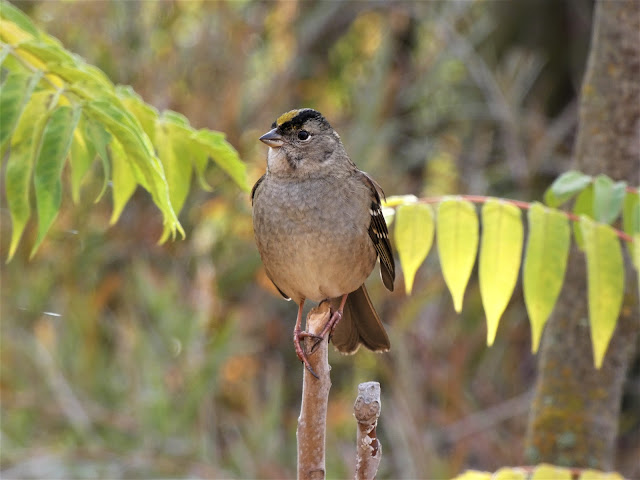
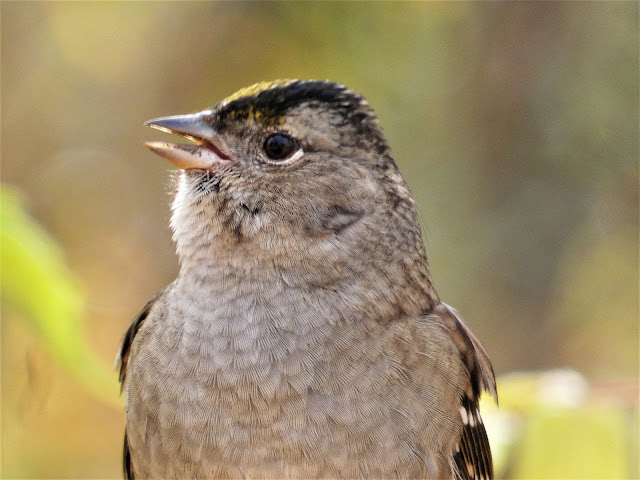
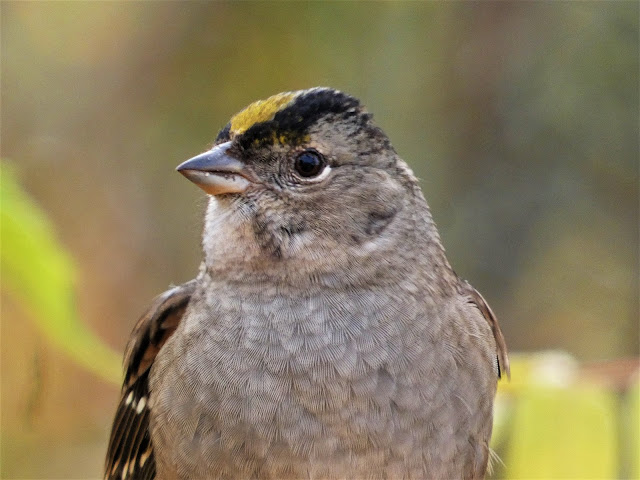
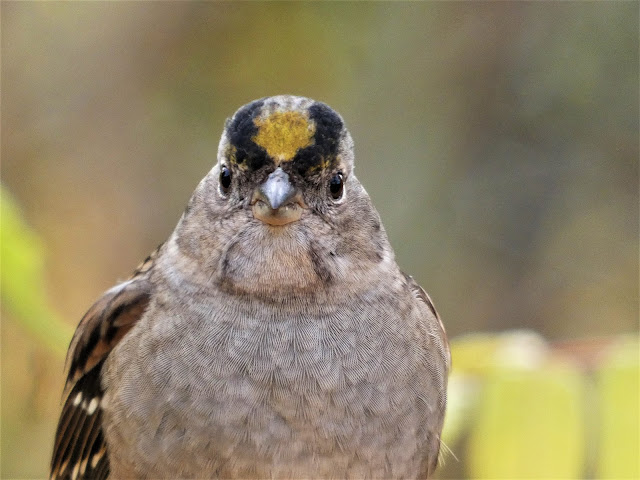
We're not afraid of asking the tough questions here at Geotripper, and sometimes we might even answer them. Today it's about the Golden-crowned Sparrow (Zonotrichia atricapilla): Why do we call them that? The answer: they are sparrows, and they tend to have golden crowns! It's a little more vivid during the breeding season, but the sparrow I ran into yesterday had one, however faded. I was on my normal walk along the Tuolumne River Parkway Trail.

It turns out that even though the sparrow is relatively common in our area, and I've been doing this blog since 2014, I've only once devoted a post to this attractive little bird. This individual decided to change that. The Golden-crowns are migratory birds, spending the summer in the far north. They only started arriving back in our region in the last few weeks. I'm really bad at remembering the songs of most birds, and heard a mostly unfamiliar song in the brush. I suspected it might be a Golden-crowned Sparrow, so I quietly played the song on my phone, and out came this bird, which perched at my eye level, and started at me. It didn't move while I took one shot after another.
Those of you who don't live on the Pacific Coast might not recognize this sparrow. It is closely related to the White-crowned Sparrow that is found across North America, but the Golden-crowned only occasionally wanders east of the Sierra Nevada and Cascades, although there have been rare sightings on the Atlantic Coast states and elsewhere. According to AllAboutBirds, the sparrow is one of the more poorly studied species in its Arctic summer home. Maybe there is a job for a budding ornithologist there...
"I'll thank you not to study ME, good sir"


Thursday, September 30, 2021

A New Bird on the Tuolumne River! A Pectoral Sandpiper

I always seem to have to say that I'm really new at this birdwatching business, even though it's been going on for five or six years. The problem is that I get pretty good at identifying the birds I see often in my travels, especially along the Tuolumne River Parkway Trail that I walk almost every day. If I see something out of the ordinary, I usually know that it is something that I have to try and photograph and identify. But sometimes I miss things that are staring me right in the face. It's a case of seeing what you look for, and not seeing what you are not looking for.

For years, I've been watching the couple of species of shorebirds that hang out at the water treatment plant on the midway part of the trail. There are almost always Greater Yellowlegs, Least Sandpipers, Spotted Sandpipers, and Killdeers. I get to the point that I don't think other birds will show up, so I don't look for them. This is usually a bad idea in birding!

So it took another birder, someone more perceptive than I, to wander along the bluff, watching the shorebirds in the treatment plant ponds. Yesterday that person was fellow nature blogger Siera Nystrom (Natural History Journal) who walked the trail and noticed a bird that was not like the others. She got some pictures and reported that she had found a Pectoral Sandpiper (Calidris melanotos). It's a special find, as it is rare in the region. It's the first sighting in the county this year, and only the 12th sighting of all time on eBird in the Stanislaus region. The nearest other known bird of this species is presently at the Merced National Wildlife Refuge an hour to the south of the Tuolumne River. So all in all, quite an accomplishment for Siera, and for the bird itself, which happens to be on a very long journey.

The Pectoral Sandpiper is rare around here because the bird is only passing through on a very long migration, and the routes the species follows are mostly in the eastern United States. That migration is pretty extraordinary, as the bird breeds in the far Arctic north, but migrates in winter not just to Mexico or Central America, but into the southern parts of South America!

Source: Pectoral Sandpiper Range Map, All About Birds, Cornell Lab of Ornithology

Once I saw Siera's species report, all I could do was sit on my hands and teach my courses all day. I waited very patiently while the students finished up the last of their labs, and I rushed out to the river trail, camera in hand, hoping against hope that the bird would still be hanging out at the treatment plant. Much to my relief, I saw it right away, because as I said above, "you see what you are looking for". I was able to get a fair number of decent pictures to share. If you decide to seek it out, it is a medium-sized shorebird with yellowish-olive legs. It's slightly bigger than a Killdeer (I think), and definitely smaller than a Greater Yellowlegs. The most distinctive coloration is the brown streaks that run down the breast, but abruptly change over to a white belly.

I tried to get a better shot, but this was a Greater Yellowlegs behind the Sandpiper...


There is one other point of distinction about the discovery of this Pectoral Sandpiper. It is the 150th species reported for the Tuolumne River Parkway Trail! It is also the 123rd species seen this year on the river, which is a one-year record, and we still have three more months to find a few more.
 

Saturday, August 14, 2021

A Real Gem on the Tuolumne River: A Lazuli Bunting

There's a semi-precious gemstone called lapis lazuli. It's actually a metamorphic rock containing a variety of minerals, but the intense blue is caused by a mineral called lazurite. It's often speckled with small grains of gold-colored pyrite. The gem has been mined for thousands of years, especially in Afghanistan, Russia, and Chile. I got to collect some once in one of the very few spots in California where it can sometimes be found. The intense blue of the mineral has led to its use as a pigment in oil paints in Medieval times (the color ultramarine), and is especially associated with the Virgin Mary.
I love the color blue, and I am lucky to have a number of bright blue birds that are common locally, including the Tree Swallow, California Scrub Jay and the Western Bluebird. But there are some blue birds that are exceedingly rare, at least in my experience, including the Blue Grosbeak and the subject of today's post, the Lazuli Bunting (Passerina amoena). They're real gems. If I am lucky, I'll spy them two or three times in a year. It's even rarer to get a half-decent picture.
I saw the first Lazuli Bunting of the year a few weeks ago after a good friend insisted she was hearing one near the trailhead for the Tuolumne River Parkway Trail where I walk nearly every day. Her observation was spot on as I got a brief look at a male. But the pictures were very grainy. Today though, I was walking along the river trail when I spotted a small bird in the distance. I thought it was another sparrow, but it was perched vertically which raised my suspicion that it wasn't a 'normal' bird. I got the binoculars out and saw the chestnut color on the breast, but I still couldn't see it clearly. I carefully drew near and the intense blue color became apparent. The bird was nice enough to hang out long enough to get some of the best pictures I've ever captured.
The Lazuli Buntings are summertime migrants in our region, and indeed across much of the western states and southernmost Canada. Come winter they'll be in Mexico. Although their Latin name means "beautiful sparrow", they are more closely related to the Cardinals and Grosbeaks.


Sunday, March 7, 2021

White-breasted Nuthatches on the Tuolumne River Trail

Few things make me happier than finding a White-breasted Nuthatch (Sitta carolinensis) on the trail I walk most days along the Tuolumne River. One of those things is to find TWO White-breasted Nuthatches on the trail. That happened today and I even got a picture. Other people seem to have no trouble finding them, but for me it's fairly rare to see them.

There has been an increase in the number of the bird sightings these last few weeks as spring approaches, and so I've been paying more careful attention to movements along the trunks and branches of the Valley Oaks along the trail. Sometimes the birds turn out not to be Yellow-rumped Warblers (who are fairly common this time of year). The nuthatches spend much of their time upside-down as they search the nooks and crannies in the bark for delectable insects and spiders. They are beautiful birds.


Monday, February 1, 2021

It's Been Awhile: Bald Eagle on the Tuolumne River Today

My friends in the Pacific Northwest, Alaska and Canada might not be much impressed by a sighting of a Bald Eagle on the Tuolumne River Parkway Trail today. But it was memorable. I saw not a single one on the trail last year (a good friend saw one, though). In fact, I only saw one anywhere in the entire county last year. The last eagle I saw here hung around for a few short weeks in 2019, and that was the first recorded sighting for that part of the river ever (although neighbors have told me of past sightings).

I had been seeing Turkey Vultures and Red-tailed Hawks (three of them!) soaring around the western part of the trail, but didn't think much of it. But then a large black shape soared overhead and I saw both a white head and white tail. I tried to get a picture but it was gone. Then I walked back upstream and saw it perched in a cottonwood across the river. Apparently the hawks and the vulture had been expressing a certain amount of concern because they were all circling the perched eagle. The eagle was unperturbed and was still perched in the same spot when I left towards home.


Monday, January 25, 2021

Someone Else Missed the Text on Migration: Hooded Orioles in my Backyard

Spring is such a wonderful time along the Tuolumne River as I eagerly await the arrival of my favorite tropical migrants: the Black-headed Grosbeaks, Blue Grosbeaks, Bullock's Orioles, the Lazuli Buntings, and perhaps my all-time favorite, the Hooded Oriole (Icterus cucullatus). But the birds have not entirely cooperated this year, as I discovered that a Black-headed Grosbeak was in fact wintering along the Tuolumne River. But even in that context, today was a real shocker.
I just happened to look out the window at the hummingbird feeder this morning and saw an unusually large bird perched there. I realized with a shock that it was a Hooded Oriole! Such things need documenting, so I grabbed my camera and got a few shots before it flew off. I thought it might come back after a bit, so I kept the camera handy and sure enough a few minutes later it came by again, and gave me a sharp stare. But then, the another surprise...

A few minutes later the Oriole had come back, but when I looked at the tail, I realized it was not the same bird. The tail was yellow, not black. This was a second Oriole, and it was a female! I never got  shot of the head, so a picture of a bird butt will have to suffice. The birds came back about five hours later, and I got a more convincing look at the female, but no pictures.

This is actually the second time that I've witnessed a Hooded Oriole pair over-wintering near the Tuolumne River. There was a pair that spent the 2020 winter in some palm trees overlooking the Tuolumne River Parkway Trail, and I am curious as to whether these are the same birds. If they have a secure winter food source, why make the perilous journey to Mexico and Central America? My yard is only a half mile from the palms where last year's birds stayed.
 

Wednesday, January 13, 2021

Wait, Why Are They Called "Ruby-crowned" Kinglets?

Want a challenge? Try to photograph a Ruby-crowned Kinglet (Regulus calendula). They are brazen little birds, willing to get right in your face if you intrude into their territory, but they never seem to stop moving.

Want a real challenge? Try and capture why they are called "Ruby-crowned" Kinglets. The males have a red patch on their head, and if they are really upset about something, it can be raised, but that happens rarely in my experiences so far. But today I managed to catch a couple of shots so you'll know what to look for on your own attempts!


Monday, January 11, 2021

Someone Missed the Text about Migration: Black-headed Grosbeak on the Tuolumne River

You never, ever know what you'll see when you set out on an adventure, however modest. Today I was taking my normal birdwatching/exercise stroll on the Tuolumne River Parkway Trail, and many of the normal birds were present. But I was about halfway through when a very unfamiliar sight appeared, one that made my jaw drop: a Black-headed Grosbeak (Pheucticus melanocephalus). These birds are found along the river, and I've seen them a few dozen times...but never, ever in winter. These are tropical birds who spend their winters in Mexico and Central America. According to eBird there are a grand total of six of them in all of California at the moment.

I don't know why this bird is still hanging around. They have a diverse diet of bugs, fruits, nuts, and seeds, and maybe this bird has a secure food source, perhaps some neighborhood bird feeders. Maybe it was injured in some way and wasn't able to make the journey with the others. There have been other winter stragglers in this area...last year it was a Hooded Oriole pair that spent the winter along the trail.


Saturday, November 28, 2020

Another Fine Day for Phainopeplas!

It often seems to happen this way. I don't post for a long time, then I finally do, and like the next day I get far better pictures than the ones that I posted earlier. And that's what happened. On two different days this week, I had some beautiful moments with the Phainopeplas (Phainopepla nitens) that have temporarily taken up residence on the elderberry bushes along the Tuolumne River Parkway Trail. I got decent pictures of a male (the black one), and the female (gray).
The Phainopeplas are really a desert species, most at home in the arid regions of the southwestern U.S. and northern Mexico, especially Baja California. They have been seen more and more in California's Great Valley, presumably as drier and warmer climates begin to prevail as the average temperature of the Earth continues to rise. They are now breeding in the valley as far north as Redding.
Phainopeplas are in the family of the silky-flycatchers, but they are not closely related to other flycatchers found in the United States. According to Ebird, they are most closely related to the Cedar Waxwings.


Saturday, November 14, 2020

Finally a Few Phainopeplas on the Tuolumne River Parkway!

I really miss blogging. I miss the freedom and creativity that comes with writing these posts, but the COVID pandemic has affected my output in the worst way, for the sole reason that I have been spending all my time preparing classes for our online teaching environment. There is creativity sometimes involved with it, but not in a fun way.
In any case, they finally arrived! I have a lot of favorite bird species, and I see some of them every day, but some stand out because of their relative rarity or spectacular plumage: the Orioles, Grosbeaks, and Buntings come to mind. But for whatever reason, the birds I really look forward to sighting for the first time each year are the Phainopeplas (Phainopepla nitens). And they were a long time coming this year. In 2020, I saw the first Phainopepla on the Tuolumne River Parkway Trail only three or four days ago. The first gave me fits, because the only picture I achieved that first day was the one above. Can you even see it?
I had better luck the next day, catching a male (the black ones) out in the open. I had trouble figuring out just how many there were, either two or three, including a female.
Today was the best, as a female broke away from the Elderberry thicket and landed on a Russian Olive only a few yards from me. The only difficulty was the blowing wind. The bird stuck around for at least five minutes in perfect range for photos, but was a moving target the whole time.
The Phainopeplas are actually a desert species more likely to be seen in the Southwest states. Apparently they have been expanding more to the north, perhaps related to the changing climate. In any case, a day with Phainopeplas in it is always a fine day!