Showing posts with label Elanus leucurus. Show all posts

Wednesday, January 26, 2022

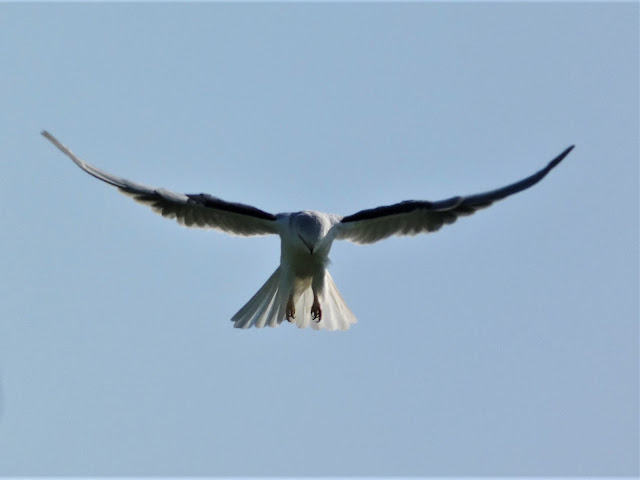
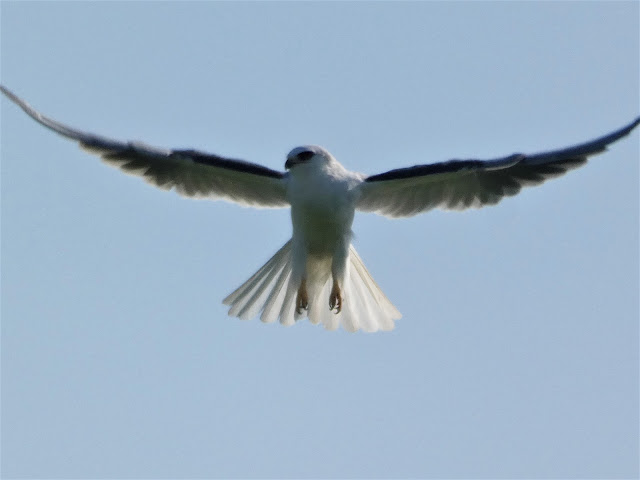
Oh, To Soar Like an Eagle, or... To Kite Like a Kite!

You just never know when a moment of beauty and grandeur will happen. People look at me strangely whenever I go out the door on a mundane errand with my camera in tow, but I've missed too many such moments to ever want to be caught without the camera.
So today it was the pharmacy and the grocery store. We live in an outlying area where the locals refuse to wear masks and get vaccinated, so I headed into the big town, passing a local farm road called Bentley Road. It's still mostly ranching lands, so the prairie birds can often be seen there by birders. It was there that I spied my first White-tailed Kite (Elanus leucurus) of the year, and it was doing what Kites are famous for doing: kiting. That's the talent of hovering in place over the fields to catch the hard-to-spy movements of small rodents and other creatures. Birds in flight are pretty hard to photograph, but a kiting Kite at least stays in one spot while flapping its wings.
The White-tailed Kite is neither rare nor common in our area. The reports for the new year number fewer than ten. I'll see them a few dozen times this year perhaps, but nowhere near the number of times I'll see the Red-tailed Hawks. They have a limited range in the United States, extending through California, parts of the Oregon coast, and a bit of southern Texas. They are beautiful birds, and my breath catches just a little whenever I spy one.

The Kite was kind enough to stay motionless long enough for me to grab the camera and snap a few pictures. I didn't have the time to see if this particular hunt was successful.

I was thinking the Kite was behaving like a drone, but Kites have been around far longer than drones. The proper historical attitude would be that drones are just basically artificial Kites.

 

Sunday, August 29, 2021

Why do they call it a White-Tailed Kite? And why do I take my camera EVERYWHERE?


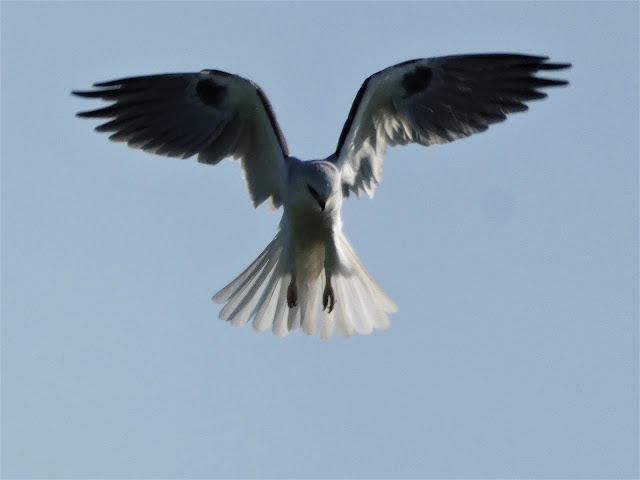
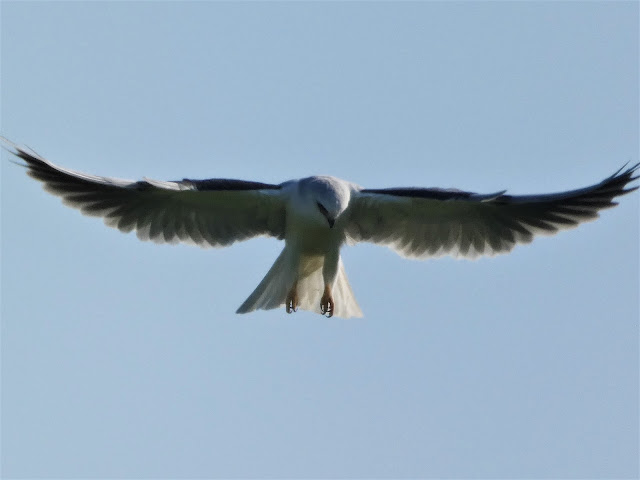
Really, both of the questions in the title are easily answered. It's called a White-tailed Kite (Elanus leucurus) because it has a white tail, and it kites. If you are unfamiliar with the term, it's maybe more related to kites that you fly with a string and all because the appearance is much the same. Kites are known for their habit of flying in place without moving as if they were attached to a string, watching for prey in the grassy fields below. A few other birds do it, but these birds are real masters. And they are my favorite raptors.
Strangely enough, today's pictures happened because another bird was kiting in the pasture-lands along Bentley Road east of Modesto. I couldn't see it well because of the sun angle, so I stopped to get the binoculars. It turned out to be an American Kestrel, but then I noticed there was a Kite on the fence post not forty feet from my car.
The camera was on the seat beside me, but the windows blocked a good angle for getting photos. I inched the car forward and raised the camera, but just as I clicked it flew away. I said to myself "of course" because that's what always happens, but to my great surprise, it simply flew across the road and landed just a bit behind me, no more than eighty feet away. And it was contentedly munching on lunch, which was some kind of small rodent. I took around 35 pictures because no Kite has ever allowed me to be so close. These are the best pictures I've ever been lucky enough to capture. It actually took me several minutes to realize there were two more Kites out in the meadow beyond the first.
And that brings up answer to the second question: Why do I take my camera EVERYWHERE? Because you never know what will happen when you are out and about. I was simply out to get a few things at the grocery store. If I had not brought the camera, I would have missed these shots.


Sunday, February 3, 2019

Flying Kites at the San Luis National Wildlife Refuge (Bear Creek Unit)


No, not those kite things on a string. These were White-tailed Kites (Elanus leucurus) at the San Luis National Wildlife Refuge. We were thrilled to see not one, but two of them, and even better, I got the best pictures I've ever managed to take.  I don't see the White-tailed Kites very often, maybe only four or five times, and so they've only made two appearances on this blog. I even got the eyes, and that hasn't happened before.
The San Luis National Wildlife Refuge is one of the premier places in California for bird watching. The main visitor-related portions of the refuge include a new visitor center and two marvelous auto-tour routes along with a number of hiking trails. There's even a large compound where visitors can see one of the few herds of California's unique Tule Elk. On eBird, more than a thousand bird counts have been conducted here.

But there's sort of a step-child at the refuge. It's called the Bear Creek Unit. It's northwest of the main part of the refuge, but is easily accessed from Highway 165. There is a two-mile long auto-tour, but only just over a hundred birding reports have ever been conducted there. I'm not sure why, but the area just didn't get the visitation. Sometimes there is a simple lack of water in the wetlands so few birds are around. Yesterday we had the place to ourselves aside from one other car. And there were quite a few birds out and about, including several thousand Red-winged Blackbirds. And...two White-tailed Kites!
The refuge system in the Great Valley preserves in some cases and works in others to reconstruct the native ecosystem that existed here in the millennia before colonizers established the vast network of farms and ranches. The valley is critical winter habitat for millions of migratory birds, and they survive only because of the string of refuges up and down the landscape. It was marvelous to experience the sky and prairie yesterday during a break in the huge storm that slammed into California this weekend.

Tuesday, March 20, 2018

White-tailed Kite on the Tuolumne River Bluffs

I had quite a surprise the other day while wandering through my usual haunts along the Tuolumne River in Waterford. I was having a relatively good birding day with more than twenty species sighted, although no new ones were noted. I struggled up the stairway (135 steps; it's a new favorite exercise spot in my town) and got in the car to go home when I noticed a large bird over the fallow cornfield at the north end of the parking lot.
It was white...and it was kiting! Kiting in this case does not involve bouncing checks (a fraud from the earlier non-digital banking days), but instead involves hovering, or gliding in place over a field, waiting for a rodent to make the wrong move. Northern Harriers do this to an extent, but the experts are the White-tailed Kites (Elanus leucurus). They are found in the westernmost states of California, Oregon and Washington, but they are not at all common (Texas hosts a few but most are in Mexico and Central America). I've only seen three of them so far in my travels, and this one was the first I've seen near the Tuolumne River.

The Kite never landed (I wasted about 25 digital images trying to get the few slightly sharp photos seen above), and eventually it flew off to the north. In case you want to know what they look like on the ground, here is a shot I got last November on Milnes Road while commuting to work. I was as surprised as the bird was when I hit the brakes.

Monday, November 27, 2017

White-tailed Kite in the Farmlands of the Great Valley

Sometimes Mrs. Geotripper (well, everybody, really) gently derides me for hauling my camera everywhere I go, and I always say one never knows what one will see, even while doing mundane errands. Such was the case today as I was picking up some things at the CVS in town, and picking up our kitties from the kennel after the holiday. I was driving down Milnes Road, which runs through orchards and pastures east of Modesto, when I saw something with the colors of a gull, but the bearing of a raptor. I finally had a chance to get some half-decent shots of a White-tailed Kite (Elanus leucurus). I've only seen them once before, and this is their first appearance on this blog.
White-tailed Kites are not all that common, and in the United States are mostly found along the west coast and in Texas. Far more of them (96%) live in Mexico and Central and South America. They are known for their hunting habit of hovering in place over grasslands ("kiting"), waiting for something to appear.