Showing posts with label Hawai'i. Show all posts

Thursday, January 18, 2018

Common Gallinule at the Merced National Wildlife Refuge (and a not-so-common Hawaiian connection)

A new species debuts here on the blog today. During our excursion to the Merced National Wildlife Refuge last weekend we saw an unfamiliar "not-quite-a-duck" bird. I had a feeling that I should have known what it was, and finally realized it was a juvenile Common Gallinule (Gallinula galeata). It may be "common", but I think it is the first one I've photographed in California.
The Common Gallinule has been called a Common Moorhen in the past, and the species ranges from Chile to the Canadian border in North America. Strangely enough, while common in the summer across the eastern states, it rarely travels beyond the north end of the Great Valley in California.
The eBird archives indicate that many birders have seen the Gallinules at the Merced Refuge, but few of them report seeing more than one or two individuals at a time. I'll be watching more closely to see if some mature individuals are around next time. They are colorful unique birds.
Hawaiian Moorhen ('Alae 'Ula) on Oahu in the Hawaiian Islands.

It's an odd thing, but I've seen and photographed more Gallinules in Hawai'i than I have in California. Thousands of years ago a few errant individuals survived the long flight to the islands, took up residence in some of the few freshwater marshes on the islands, and evolved over time into a unique subspecies, the 'Alae 'Ula, or Hawaiian Moorhen. They are highly endangered on the islands because of habitat loss (the freshwater marshes have proven expendable in the face of intense development on Oahu and the other islands). There are less than a thousand of them today, and at one point they had declined to 57 individuals.

Sunday, July 9, 2017

The Most Hated Bird in Hawai'i? Tale of Two Invasive Species

What's the most hated bird in Hawai'i? I have no idea. I don't live there and I don't think there's an official designation for such a thing. I don't even know the most hated bird where I live for that matter (Pigeons? Crows?). In any case, the Common Myna (Acridotheres tristis tristis) might be a plausible candidate. Here are some observations from the Bishop Museum"generally vilified for its noisy habits, "quarrelsome" and opportunistic nature, disturbance to domestic pigeons, fruit-eating and nest-robbing habits, and the possibility of its adversely affecting native bird populations". Also, a song "about as musical as a cat-fight". And, somewhat mysteriously, "later writers again castigated the myna in Hawaii, pointing out its role in spreading noxious weeds including Lantana, serving as a host for parasites and avian diseases, predating seabird nests, setting buildings afire with lighted cigarettes, and perhaps competing with 'o'os for cavity nest sites". The Myna has even managed to make the list of 100 of the world's worst invasive alien species (the list has only three birds, and two of them are presently in Hawai'i).

I guess success breeds contempt. As an occasional visitor to the islands I don't have anything in particular against the bird, other than knowing of its possible impact on native species, which is debated. They are ubiquitous and loud, but also intelligent and comical. They were introduced to the islands in 1866 in an effort to control an insect pest, the Cutworm Moth. Apparently they did so, but once the pest was under control, they started to eat everything else and spread widely.
I photographed this individual in Liliuokalani Gardens in Hilo, Hawaii on the Big Island. Almost in the same moment I had a rare chance to get some close up photos of what might be the other most vilified invasive species (excepting possibly the rat): the Asian Mongoose. It's obviously not a bird, but its history is entwined with the native birds of Hawai'i. Like the Myna, it was introduced to some of the islands in an effort to control a pest, in this case the rat. The mongoose will eat rats, but it isn't their priority, since the rats are nocturnal and the mongoose is not. They instead went after the eggs and chicks of the native birds. They were quite the biological disaster, and like the myna birds, they are found almost everywhere. They never made it to Kauai, and preventing their introduction is one of the highest priorities of wildlife officials in the state.

But really, aren't they just so cute?

Thursday, July 6, 2017

Zebra Doves in Waimea Valley, Oahu


If you travel to Oahu in the Hawaiian Islands, there are certain birds you will absolutely see. There are the European Sparrows and House Finches that I also see at home all the time. Then there are the Spotted Doves and Myna Birds, which I never see back home. But probably the most common will be the Zebra Dove (Geopelia striata), which seem to be everywhere, starting with the airport lounge and baggage pickup areas (parts of Hawaiian airports don't have doors or walls due to the nice climate).

As I have mentioned previously, the birds are quite polite as a rule, hanging around for food that might drop, but aren't pushy (in my experience anyway; I have heard they'll land on tables). The doves are native to Malay Peninsula, the Philippine Islands, and Indonesia. As adept island colonizers, they didn't take long to spread to the other Hawaiian Islands after they were introduced in 1922.

It's odd, but despite the ubiquitous nature of these little doves, I've had only fair luck in photographing them. They can be very active, and sometimes I miss opportunities because in being so common, I ignore them. In any case, I got these up close and personal shots during our visit to Waimea Valley on Oahu on our last full day in the islands. Waimea used to be a high adventure amusement park kind of place, but is now maintained as a botanical garden (with a dandy waterfall and swimming hole at the upstream end).

Tuesday, June 6, 2017

A Northern Cardinal...in Hawai'i? The Very Definition of Non-native Species

So...you're walking down a tree-lined street in St. Louis, Missouri, and you see a flash of red in the branches. It's a Northern Cardinal (Cardinalis cardinalis)! You could have the same experience walking through the desert around Phoenix, Arizona. You see them on sports monograms. It's all normal stuff if you live in such places. That's where the bird occurs naturally.
But what if you are walking through an ancient kipuka (an island of unburnt vegetation within a lava flow) on the Big Island of Hawai'i? Well, that becomes strange. What is a bird of the eastern US hardwood forests and the desert southwest doing on an island more than 2,000 miles from the mainland? In the last few posts I've been exploring some of the non-native bird species of the islands, and how they have upended the original ecosystem. The alterations and changes began more than a thousand years ago, but the rate of change increased exponentially after European colonization of the islands. New bird species were purposely brought to the islands more than 150 years ago, and they brought new diseases that the natives had no resistance to. Bird species continued to be introduced throughout the 1900s, sometimes as cage releases of pets, but sometimes on purpose. The Northern Cardinals arrived about 1928, and they spread quickly to all of the main islands, and many of the minor islands as well.
It's always a shock to see a Northern Cardinal flitting through the rainforest. The bright red color really stands out against the vegetation. I saw this individual in a tree no more than 30 feet or so from the trail I was walking through the kipuka. Kipuka Puaulu is a unique place, an ancient forest of Ohia and Koa trees that managed to miss being overrun by a fairly recent basalt flow from Mauna Loa. I recently told the story of this kipuka and one other, and to me the story is absolutely fascinating; it even includes what may be the rarest plant in the world (at least for the couple of years when none existed).

It's unclear the effect the cardinals might be having on the native birds. They spread farther and higher than some of the other introduced species. In the meantime, they are beautiful birds in a spectacular setting, even if it is far removed from the original home of the species.

Monday, June 5, 2017

Red-crested Cardinals on Oahu

In 1928 or so, the coastal towns and farmlands of Hawai'i were bereft of native bird species. Non-native species brought to the islands for a number of reasons had carried in their blood the parasite that caused avian malaria. Mosquitos transferred the disease to the native birds, and they were largely extirpated from the coastal lowlands. Most of the natives only survive above 4,000 feet where it is too cold for the mosquitos to thrive.
It wasn't that there were no birds at all in the lowlands. The Common Myna, introduced in the 1850s to control pests in the sugar cane fields, was...uh...common. There were also Spotted Doves, House Finches, and European Sparrows. But these weren't enough for some of the residents. In the 1930s, a bird club called Hui Manu devoted itself to introducing colorful and interesting birds to the islands. The effort was well-meaning, but misguided as one could imagine. Some of their introductions spread well beyond the coastal forests and spread into the higher forests where the native birds struggled to hang on. The new competition didn't help matters.
In any case, a number of the introduced birds were naturalized, and have spread widely. These are the birds most likely to be seen by tourists who stay in the coastal cities. And some of them are very colorful, literally a delight to the eye. Among them most be counted the Red-crested Cardinals (Paroaria coronata). The red head and crest seem to throw off the color balance on my camera sometimes. I saw them all over Oahu, but got the closest when we visited Waimea Valley on the North Shore, and at Kualoa Regional Park west of Kailua. Kualoa is one of the most beautiful shorelines on Oahu.

The Red-crested Cardinals rarely venture above 1,200 feet, so they probably can't be regarded as one of the "bad" invasive species that threaten the livelihood of the native species of Hawai'i. They certainly add a splash of color to the urban and developed areas of the islands.

Sunday, June 4, 2017

And Here's the Grown-up Shama Thrush at Waimea Valley

The Shama Thrush (Copsychus malabaricus) is native to southeast Asia, but was introduced into the Hawaiian Islands in the 1930s-1940s. It has spread widely through the coastal forests of Oahu and Kauai, and would have competed against the native species, except that the natives had been extirpated by avian malaria and lost habitat. Some of them have in fact spread into the higher altitude forests where they may cause problems for the natives.

Thus it is that I have ambivalent feelings about the non-natives. I deplore the destruction of the original habitat and the loss of so many native species, but I also couldn't wish for the silent forests that led some well-meaning people to release their caged birds as a way of repopulating the coastal forests of Hawai'i. And certainly many of the new birds are colorful and interesting.
We saw this male Shama Thrush while we strolled through Waimea Valley on the North Shore of Oahu (we saw the juvenile and a female in yesterday's post). Like the bird, Waimea Valley is not exactly natural either. It's a botanical garden, filled with plants from all over the world. In an odd way, that makes the presence of the Shama Thrush a little less out of place. In any case, it is a beautiful sight.

Saturday, June 3, 2017

Juvenile Shama Thrush in Waimea Valley on Oahu

A visit to the Hawaiian Islands for birding-type people can be an exercise in frustration. Hawai'i is well-known as an example of evolution in action: isolated islands that were colonized thousands or millions of years ago, producing myriads of new and fascinating species, including birds. For instance, the honeycreepers, small finch-type birds, diverged into at least four dozen new species. Most are extinct, but some are left, and finding them can make or break a trip, depending on how focused your goals are. The problem is that mosquitoes were introduced to the islands in the early 1820s, and they brought avian malaria. The disease wiped out the native birds in the coastal areas. The species that survived found refuge in the forests above 4,000 feet, where it is too cold for the mosquitoes to thrive, but the coastal forests became silent.

Invasive species were introduced for a variety of reasons. In some cases, such as with the Myna Birds, they were brought as a method of controlling pests in the sugar cane fields. In others, caged birds escaped from their owners. In at least one case that I heard of, a pet shop went bankrupt, and the owner simply let all of his birds go. There were even well-meaning people who released birds on purpose to repopulate the coastal forests with songbirds. Overall, these new species put even more pressure on the natives, as they often competed for the same food sources.

So birding on the islands is a mixed bag. As a rule, one will not see native species unless a special effort is made to visit their habitats. And yet, the invasive birds are often quite beautiful speciess that have become naturalized in their new habitat. They are colorful and are often easy to photograph in heavily visited tourist areas. As such, they'll be the focus of my next few posts. While we were on Oahu, we made sure to get out of Honolulu and explore the wilder parts of the island, including the Waimea Valley on the North Shore.
Waimea Valley is not exactly a native Hawaiian habitat. It was once an adventure park that has since been converted into a botanical garden with species from all over the world.  It therefore almost makes sense that exotic bird species would be common here as well. As we walked down the pathway, I saw an unfamiliar bird on the basalt boulders and got some pictures. I was starting to thumbing through the bird guide to identify it when I realized it was a juvenile, mainly because momma showed up to feed the hungry teenager. It was a Shama Thrush (Copsychus malabaricus), sometimes called the White-rumped Shama. It's a native of Asia that was introduced in the 1940s. The guidebookss share the collective opinion that it has one of the finest songs on the islands.
There were male Shamas in the park too. They'll be in the next post.

Monday, May 22, 2017

'Apapane (at last!) at Hawai'i Volcanoes National Park

Several million years ago, a small finch species, either pregnant or part of a small flock, got blown off course and somehow survived a tortuous passage over two thousand miles of ocean to land on the newly emergent Hawaiian Islands. The circumstance seems unlikely, but it only had to happen once. The birds discovered some kind of food that kept them alive, but over time, the populations became isolated as they searched for different food sources. Some were scattered on other islands. Over time they evolved, eventually diverging into four dozen or more species. These so-called Honeycreepers were more diverse than Charles Darwin's celebrated Galapagos finches. Time (and human intervention) was not kind to most of the species, and many went extinct. Today there are only a dozen or so left, and some of them are exceedingly rare (as in less than a dozen birds remaining). The reasons are many, but the biggest cause in recent time has been the spread of avian malaria, caused by introduced species of mosquitos. Today, most of the Honeycreepers survive in high-altitude forests where it is too cold for the mosquitos.


I've only seen a few of the Honeycreepers, perhaps just three species, and I've captured decent shots of none, which explains their absences from these pages so far. I'm on the Big Island this week, however, and I spent the last two days in Hawai'i Volcanoes National Park. We were exploring the edge of an intriguing pit crater called the Devils Throat when I saw a bird soaring on the far side. It landed for a few moments and I was able to confirm: it was a Honeycreeper called the 'Apanane (Himatione sanguinea). These are the pictures I got, at extreme zoom from about 150-200 meters away.

The bright red plumage of the 'apanane found its way into many robes of royal Hawaiians, but the birds were prolific enough to escape extinction when the islands were colonized. They are considered secure for the time being as long as an "island" of cooler air remains above the 4,000 foot level where mosquitos can't thrive (some of the birds may be developing resistance to malaria as well). Their current population on the islands is estimated to be just over a million individuals. And I finally photographed one of them!
The Devils Throat lava pit. I love my camera; the pictures above were on a bird in the shrubs on the opposite rim several hundred feet away.

Saturday, May 20, 2017

'Auku'u, the Black-crowned Night Heron in Hilo (the Return!)

I'm back in the Hawaiian Islands this week! It explains the relative lack of blogging anywhere, and I have precious little time for hunting birds (the topic of the week is geology, and the excuse for being in the islands is a conference and conference-related field trip). But still, I watch for them when I can, and I had a good opportunity early this morning.
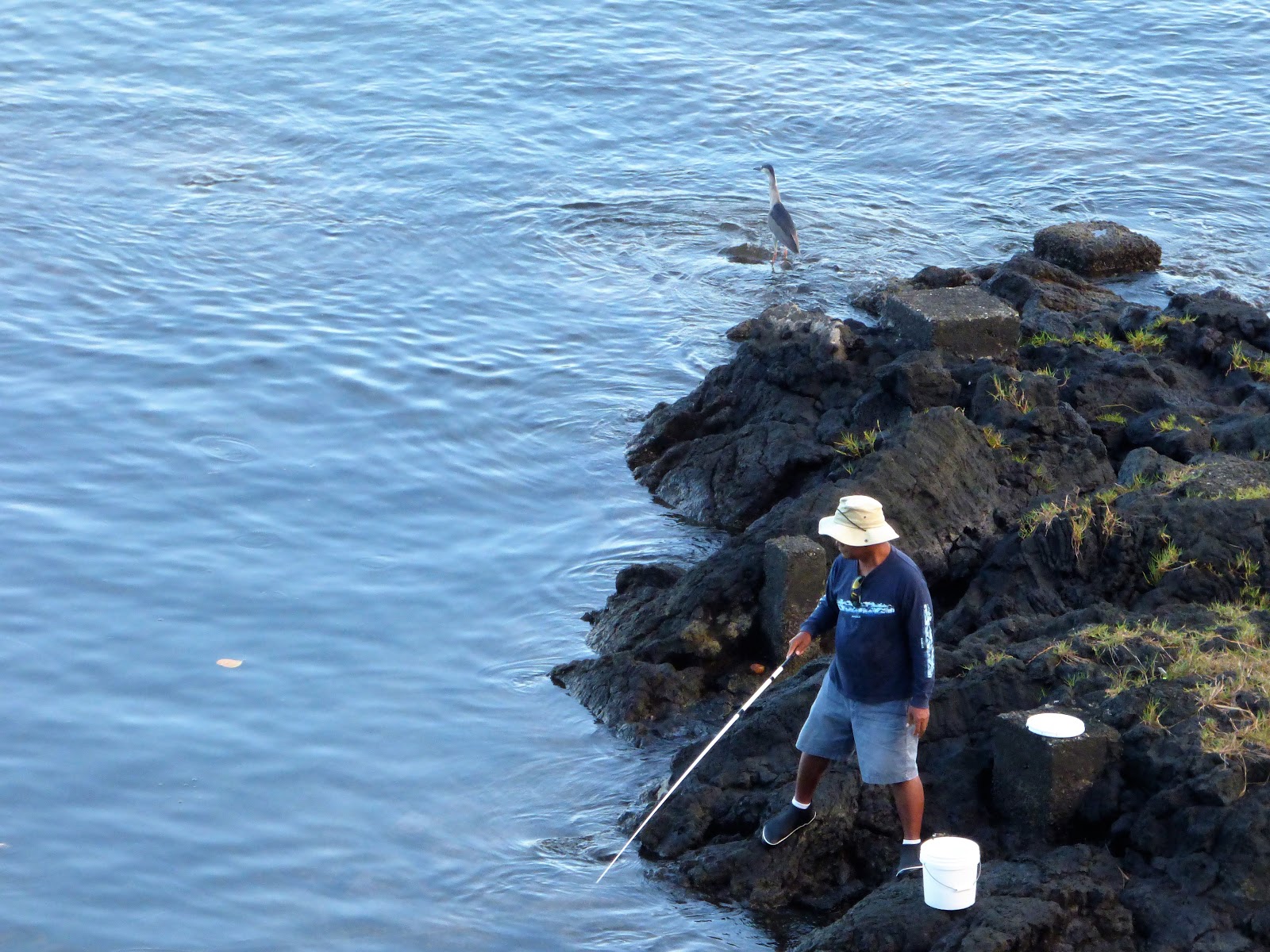
I was last here about a year ago, and I had a short post showing the 'Auku'u (Black-crowned Night Heron; Nycticorax nycticorax) at night searching for fish in Hilo Bay in front of the Hilo Hawaiian Hotel. I never got a good luck of the bird in the daytime. That changed this morning. I spied him from my window hanging out with the fishermen along the shore, and went downstairs to see if I could get a closer look. It didn't seem too concerned about humans, given that some were standing just a few yards away.
The 'Auku'u is of a special breed, that of a bird that is native to the Hawaiian Islands.  The ancestors of this bird arrived by chance thousands of years, maybe tens of thousands of years ago and established populations here. Unlike other species which have undergone intense evolutionary change, the Heron is more or less indistinguishable from its mainland relatives. If you have good adaptations, you stick with them!

Friday, July 8, 2016

Common Waxbills at Kona on the Big Island of Hawai'i

It's a week of ugly and tragic news. I'm not ignoring it, I'm following closely. But I'm also choosing to find some small bit of beauty in the midst of tragedy.  Common Waxbills (Estrilda astrild) are native to Africa south of the Sahara Desert, but they were introduced to the Hawaiian Islands in fairly recent time, the 1970s. They were first noted on Oahu, but showed up in the Kona area on the Big Island only in 2002 or so. They feed mainly on grass seeds.

We saw these Waxbills at Maka'eo Jogging/Walking Path at the Old Airport Park just north of Kona on the Big Island. A small bit of beauty.

Tuesday, June 28, 2016

'Io, the Hawaiian Hawk at the Pololu Valley on the Big Island

It was on my very first trip to the Hawaiian Islands that I started paying attention to birds, in large part because of the presence of a Hawaiian Hawk, or 'Io, at the Hilo Zoo. It immediately raised questions, mainly, how in the world did a hawk get to Hawai'i? They aren't shorebirds, and they can't swim, so at least once, a small group (or a pregnant female) got knocked off course, and kept soaring until they were lucky enough to sight land. Ever since the day I saw the Hawaiian Hawk (Buteo solitarius) at the zoo in 2002, I've wanted to see one in the wild. It took a long time.
I was with my students a few weeks ago at the Pololu Valley trailhead at the north end of the Big Island when I heard an unearthly screeching from right over my head in a coconut tree. I looked up and saw what I momentarily assumed was a pigeon, but in a split second I realized it was too big. I was trying to recall what kind of large bird would be perched in a coconut tree when it struck me: Hawk! I was immediately struggling to bring my camera around, but a pair of Common Myna Birds didn't want the hawk around. They chased it away before I snapped more than a pair of pictures. I got one of the hawk soaring above.
Although fossils of the hawk are known from Kaua'i, Moloka'i, and Oahu, they only live today on the Big Island, where they feed on insects, birds, and introduced rats. They are on the endangered species list, but their population seems to be stable at around 3,000 for the last 20 years. 
Hawaiian Hawk in the Hilo Zoo (2002)

Friday, June 17, 2016

Saffron Finch on the Big Island of Hawai'i

We are going outside of California for awhile, since I was overseas on the Hawaiian Islands, and to say that there are lots of birds there is an understatement. There are lots, and only a few are at all familiar to Californians. There are both native birds and introduced (even invasive) species, and the introduced birds are the most visible. You really have to work at seeing the natives, as they have been driven into the high elevation forests for reasons to be discussed later.
In the meantime, the introduced species provide a splash of color to the exploration of the islands, and one of the most striking birds one can encounter is the Saffron Finch (Sicalis flaveola). It is a tanager that is native to the Amazon Basin in South America (it certainly bears some resemblance to the Western Tanager back home in California). 

The Saffron Finches are popular cage birds, and that is the probable explanation for their existence in the Hawaiian Islands. They were first noted in the 1960s and were most likely escapees. They are common on the Big Island, and increasing in Oahu as well.

I encountered several of the finches at our first hotel on the day of our arrival, but it wasn't until several days later that we were exploring Lapakahi State Park on the northern coast that we saw one up close. Lapakahi preserves an ancient fishing village. We spied the finch "hiding" in a tree above a burial site ("hiding" is a strong term for such a colorful bird).

Later on we stopped in Kapa'au on the northern tip of the Big Island, and had another finch land nearby the group. I like the color contrast with the red paint on the roof.

Expect a lot more colorful birds in coming weeks. There were a lot of them out there!