Showing posts with label Aleutian Cackling Goose (Branta hutchinsii). Show all posts
Wednesday, January 22, 2020
One of Nature's Most Awesome Displays, and only 10 Miles from my College
I find it staggering sometimes that I lived in the Modesto area for more than two decades before I discovered that one of the most awesome displays of nature was taking place only a short distance away. I've watched plenty of nature documentaries about the vast bird flocks of the Serengeti Plains of Africa, and dreamed of seeing such incredible sights for myself, all the while not realizing that a similar drama could be seen only ten miles outside of my town.
The Great Valley of California is a 400 mile long trough of agricultural fields that once were grassy savannahs and wetlands that support millions upon millions of migratory birds. When the region was colonized, the prairies were erased by agricultural fields and orchards, and the refugia for the migratory birds disappeared. Environmentalists and conservationists began to lobby for preserving and rebuilding some of the wetlands resulted in the establishment of a string of wildlife refuges up and down the valley. They amount to 5% or less of the original landscape, and are not really enough to support the huge bird populations, but it is better than what existed a half century ago. Each winter the refuges host hundreds of thousands of geese (Snow, Ross's, Aleutian Cackling, and Greater White-Fronted), as well as Sandhill Cranes, and millions of ducks.
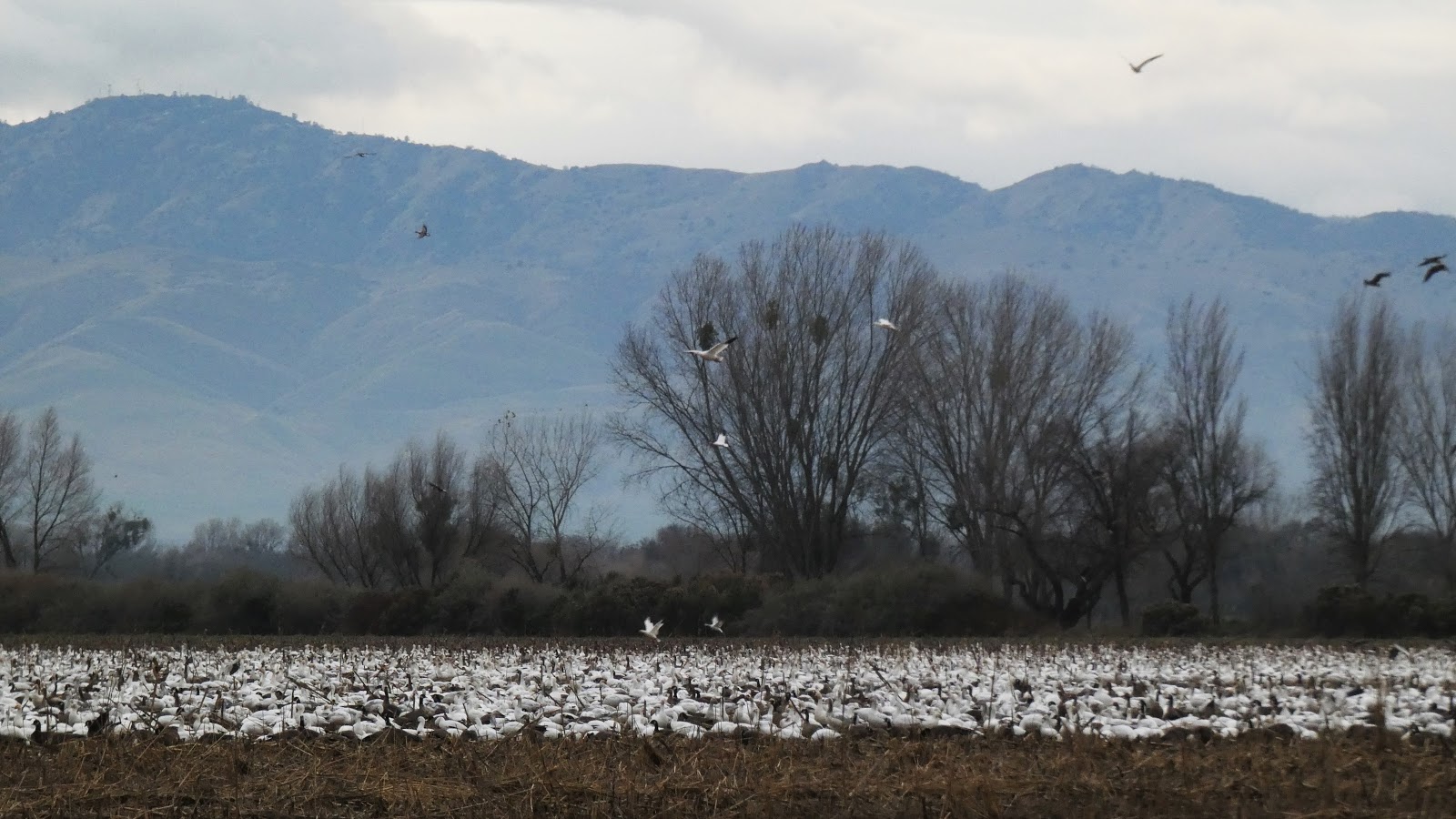
I went out to the Beckwith Road Viewing Platform west of Modesto to have a look tonight at the San Joaquin River National Wildlife Refuge. The platform overlooks hundreds of acres of land planted with corn solely meant to feed the geese and cranes. Every evening during the fall and winter, thousands, maybe tens of thousands of geese fly in for the night and gather into a single gigantic flock, a sea of white Snow and Ross's Geese, with an outer ring of Aleutian Cackling Geese. It's best when they are not disturbed so they can conserve their energy, but occasionally something will happen and the entire flock will take flight all at once. That happened while I was watching. I don't know if it was a coyote, or an eagle, but something startled the birds and off they went. It was stunning.
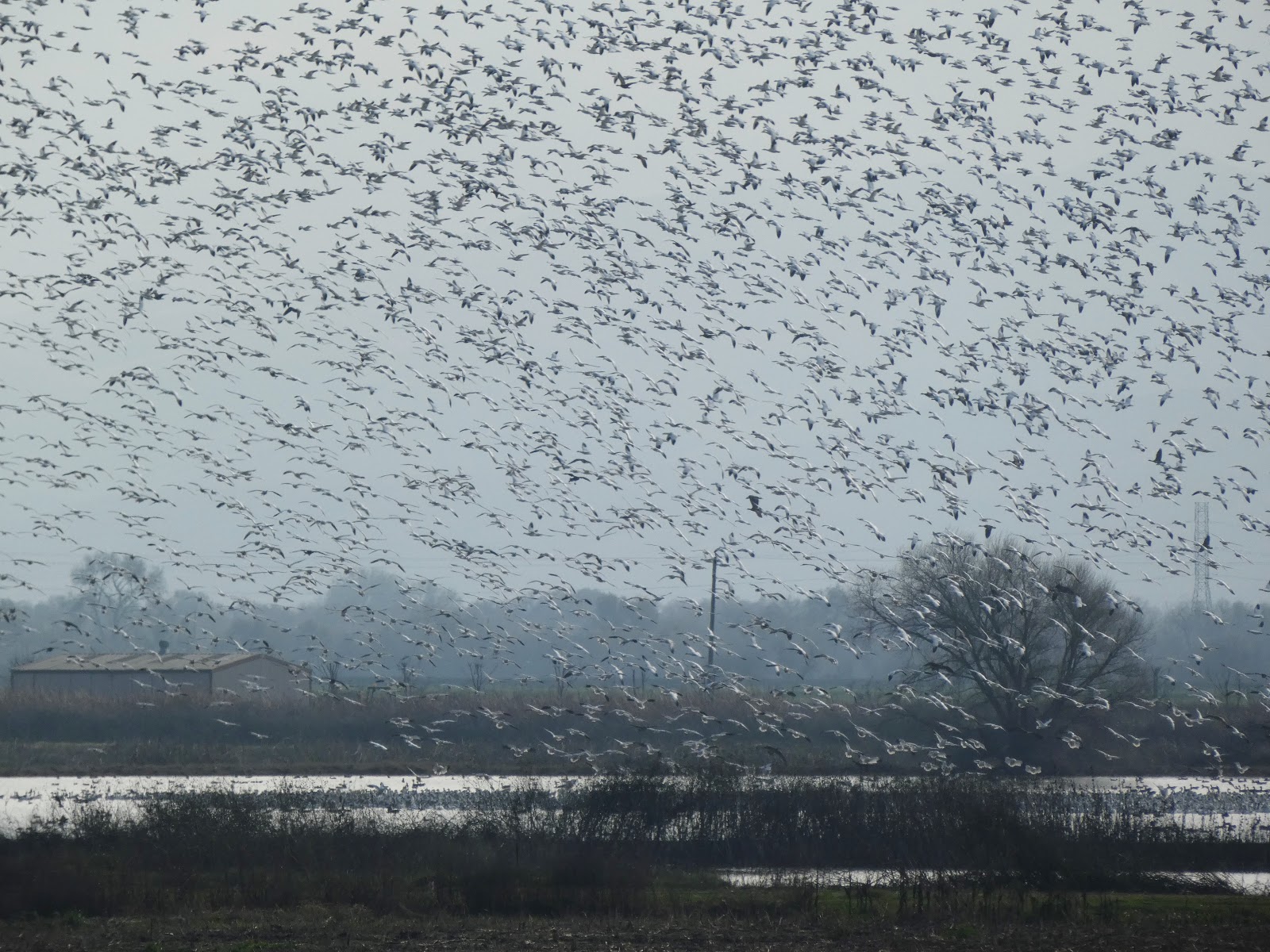
I was taking video, and as the birds began to settle back in, I noticed a single goose, an iconoclast, a loner, who had refused to take off like the others. You can see it at the end of the video. I wonder what it was thinking...
Monday, October 29, 2018
The Second Wave Has Arrived, With Harbingers of a Third: The Aleutian Cackling Geese at Beckwith Road
But this week there was a big change at the San Joaquin River National Wildlife Refuge. I stopped by on Tuesday and again on Saturday to find a huge flock of several thousand Aleutian Cackling Geese (Branta hutchinsii). The corn in the section near the viewing platform on Beckwith Road had been cut so the birds were foraging for food.
The Cackling Goose strongly resembles the Canada Goose and was once classed as a subspecies. Subsequent studies showed enough differences that they are considered separate species today. They are noticeably smaller and their necks are short than those of the Canada Goose. They breed on just a few of the Aleutian Islands and most of them migrate to just a small area of the Central Valley, primarily the San Joaquin River National Wildlife Refuge. The birds were actually thought to be extinct for a few decades after 1938, due to over-hunting in the valley and the introduction of foxes in their breeding grounds in Alaska. A few hundred individuals were discovered on an isolated island and the bird was placed on the endangered species list soon after in 1967. The foxes were removed from the breeding islands and hunting was controlled and the birds rebounded. They now number more than 120,000.
There was a harbinger in the crowd of Cackling Geese which you may have noticed in some of the pictures above. It was the presence of seven or eight Snow Geese. They are another Arctic breeder, and they are on their way south too. In another two or three weeks there will be tens of thousands of them at the refuges (my official "third wave").
The viewing platform on Beckwith Road is about eight miles west of the Vintage Faire Mall in Modesto. It's open now and free to visit. If you want the challenge of a hike you can go across the San Joaquin River on Highway 132 and go a few miles south to another section of the refuge. The Pelican Trail is about 4 miles total with a variety of different riparian habitats. It's not unusual to run across three dozen bird species or more.
The Great Valley is often thought of as a dusty, flat and boring place. It often is. But there are treasures hidden here. A visit to the national refuges during the winter migrations is as spectacular as a trip through the African savanna, especially in those moments when tens of thousands of geese take flight all at once. It is well worth your time if you ever happen to be passing through.
Here's a video of the flight...
Subscribe to:
Posts (Atom)