Sunday, March 7, 2021
White-breasted Nuthatches on the Tuolumne River Trail
Monday, February 1, 2021
It's Been Awhile: Bald Eagle on the Tuolumne River Today
I had been seeing Turkey Vultures and Red-tailed Hawks (three of them!) soaring around the western part of the trail, but didn't think much of it. But then a large black shape soared overhead and I saw both a white head and white tail. I tried to get a picture but it was gone. Then I walked back upstream and saw it perched in a cottonwood across the river. Apparently the hawks and the vulture had been expressing a certain amount of concern because they were all circling the perched eagle. The eagle was unperturbed and was still perched in the same spot when I left towards home.
Friday, January 29, 2021
One Rock Wasn't Like the Others...
The camouflage was almost perfect. It was a Burrowing Owl (Athene cunicularia) watching over the roadway. It is always a thrill to see one of these inscrutable birds, and I rarely see them more often than two or three times a year if I am lucky.
Monday, January 25, 2021
Someone Else Missed the Text on Migration: Hooded Orioles in my Backyard
I just happened to look out the window at the hummingbird feeder this morning and saw an unusually large bird perched there. I realized with a shock that it was a Hooded Oriole! Such things need documenting, so I grabbed my camera and got a few shots before it flew off. I thought it might come back after a bit, so I kept the camera handy and sure enough a few minutes later it came by again, and gave me a sharp stare. But then, the another surprise...
A few minutes later the Oriole had come back, but when I looked at the tail, I realized it was not the same bird. The tail was yellow, not black. This was a second Oriole, and it was a female! I never got shot of the head, so a picture of a bird butt will have to suffice. The birds came back about five hours later, and I got a more convincing look at the female, but no pictures.
Sunday, January 17, 2021
Vermilion Flycatcher at the Merced National Wildlife Refuge: Finally One of the Males!
I've been looking for one of the males in hopes of getting some closer shots, as the mature male in Stanislaus County is always seen from hundreds of feet away. I knew roughly where to look, but had no luck in three or four attempts. But as we rolled up to the parking area for the Bittern Marsh Trail, the bird literally flew right in front of our car and landed in the tree next to us. That led to a few moments of pandemonium as we grabbed cameras and tried to locate the bird in the thick brush. What happened next was a scene probably familiar to most birders: snapping a series of totally unfocused shots just to have some kind of confirmation that we had indeed seen the bird.
We and the bird finally settled down and I snapped the shot above, and I would have been perfectly satisfied with the result. A beautiful immature male Vermilion Flycatcher! We were blocking the road though, so we drove on and parked a few hundred feet away. I slowly walked back and saw that the bird was gone, but as I was looking around, another birder motioned to me and pointed. The bird had once again flown across the road and was now perched on a small tree next to the Bittern Marsh.
I now had a few delightful moments getting some very satisfying pictures of the young bird. If their range is indeed expanding (perhaps due to global warming), they will be a welcome addition to our region.
And now, if I could only figure out where that mature male is hiding out...
Wednesday, January 13, 2021
Wait, Why Are They Called "Ruby-crowned" Kinglets?
Want a real challenge? Try and capture why they are called "Ruby-crowned" Kinglets. The males have a red patch on their head, and if they are really upset about something, it can be raised, but that happens rarely in my experiences so far. But today I managed to catch a couple of shots so you'll know what to look for on your own attempts!
Monday, January 11, 2021
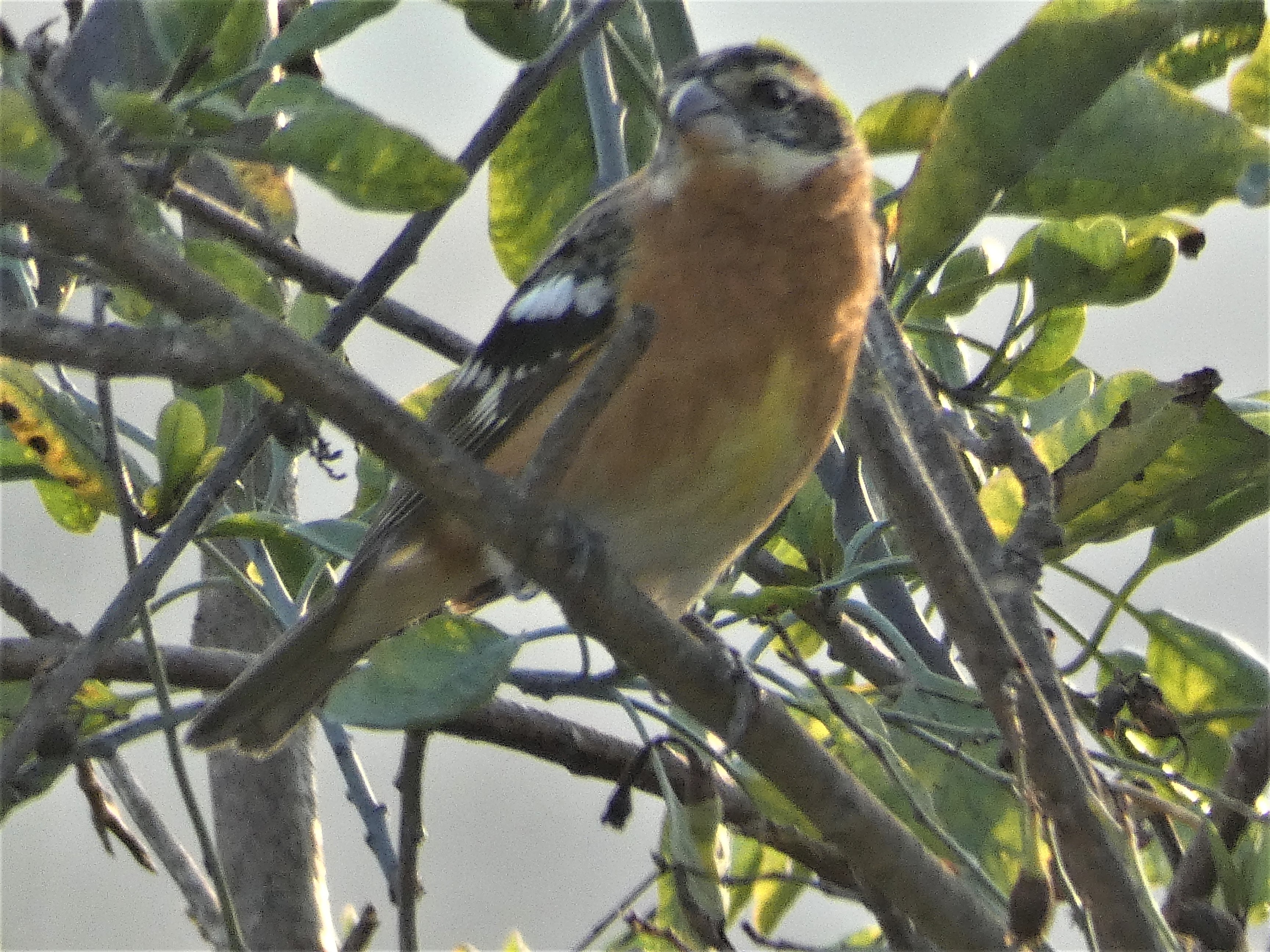
Someone Missed the Text about Migration: Black-headed Grosbeak on the Tuolumne River
I don't know why this bird is still hanging around. They have a diverse diet of bugs, fruits, nuts, and seeds, and maybe this bird has a secure food source, perhaps some neighborhood bird feeders. Maybe it was injured in some way and wasn't able to make the journey with the others. There have been other winter stragglers in this area...last year it was a Hooded Oriole pair that spent the winter along the trail.