Monday, January 11, 2021

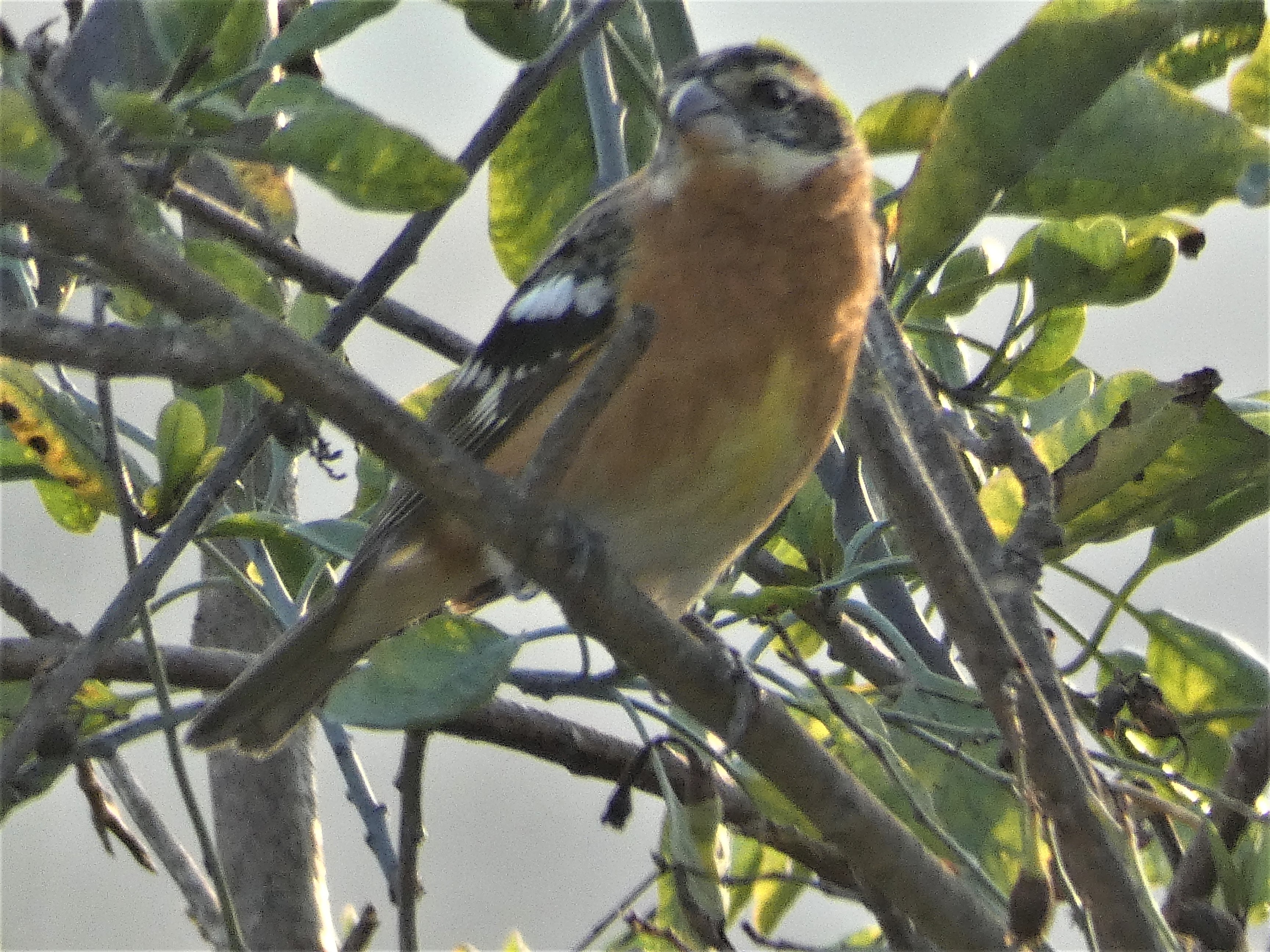
Someone Missed the Text about Migration: Black-headed Grosbeak on the Tuolumne River

You never, ever know what you'll see when you set out on an adventure, however modest. Today I was taking my normal birdwatching/exercise stroll on the Tuolumne River Parkway Trail, and many of the normal birds were present. But I was about halfway through when a very unfamiliar sight appeared, one that made my jaw drop: a Black-headed Grosbeak (Pheucticus melanocephalus). These birds are found along the river, and I've seen them a few dozen times...but never, ever in winter. These are tropical birds who spend their winters in Mexico and Central America. According to eBird there are a grand total of six of them in all of California at the moment.

I don't know why this bird is still hanging around. They have a diverse diet of bugs, fruits, nuts, and seeds, and maybe this bird has a secure food source, perhaps some neighborhood bird feeders. Maybe it was injured in some way and wasn't able to make the journey with the others. There have been other winter stragglers in this area...last year it was a Hooded Oriole pair that spent the winter along the trail.


Monday, December 28, 2020

Harbinger of Climate Change? The Vermilion Flycatchers of Stanislaus and Merced Counties

According to the eBird records, the first sighting of a Vermilion Flycatcher (Pyrocephalus rubinus) in Merced County was in 2003, and the first in Stanislaus County was in 2012 (the official records may be different). They certainly aren't common. It appears only two individuals have ever visited Stanislaus. But the numbers in Merced are intriguing. Prior to 2020 the sightings have been of a single birds that caused quite a stir among the local birders. They were outliers in other words, accidental wanderers. But this year it appears that there may be as many as seven individual birds in the county: three at Lake Yosemite, and at least three but maybe four at the Merced National Wildlife Refuge. Some are immature, suggesting that some local pairs may be breeding.
We saw our first female ever in late November at Merced NWR. It was on the west side of the auto route, and was a surprise to us because most of the sightings have been on the southeast part of the refuge. And it was perched right along the side of the road, hardly 20 feet from our car. The female  lacks the brilliant vermilion coloration, which can make it easy to miss. We didn't expect to see it again when we were there today, but there it was, almost in the same spot! It's more than a mile from where others have reported a mature male and female, and an immature male. I looked and looked but wasn't lucky enough to see the others.
The sole Vermilion Flycatcher in Stanislaus County is nothing if not consistent. He has occupied the same fence and shoreline along Dawson Lake (a small irrigation reservoir in the east part of the county) since late 2017, leaving during the summer months, but returning like clockwork in the fall. We saw him on December 16. The lake is on private property, so most pictures of this bird are from a great distance, as you can see below.
I cannot claim any specific knowledge as to why more of these birds have been sighted in the region lately, but it is a known fact that the climate is warming, and a great many species have been shifting to the north in response. The Vermilion Flycatcher is a subtropical species, being common in Mexico and Central America. Other subtropical species have become more abundant in the region, including the Blue Grosbeak and the Phainopepla. This is exciting for us local birders, but can be bad news for the species and the ecosystems they inhabit. Species move in response to availability of food sources and can cause disruptions in their new homes. The increasingly common Great-tailed Grackles for instance are aggressive feeders and have displaced other native species. In a warming world, there will be winners and losers, but mostly losers. Introducing aggressive new species into formerly stable habitats is rarely going to have a positive outcome.

Source: Vermilion Flycatcher Range Map, All About Birds, Cornell Lab of Ornithology
The Vermilion Flycatchers don't seem to be in the category of aggressive invasive species, at least not in the low numbers that have right now. As such, they are a wonderful and colorful surprise to see in our local region.

Postscript: Make that eight Vermilion Flycatchers in Merced County. Ralph Baker saw one at the San Luis NWR on November 1!

Saturday, December 19, 2020

Up Close and Personal with a Loggerhead Shrike

The Loggerhead Shrike (Lanius ludovicianus) is an interesting bird. It is most closely related to songbirds, but in life is more like a small raptor, consuming a diet of large insects, amphibians, reptiles, mammals, and even some smaller bird species. They prefer open grasslands with occasional trees or fences to perch and hunt from. I have yet to see one along the Tuolumne River Trail, but we see them fairly often at our local wildlife refuges. I've photographed them many times, but never quite this close.
We were on the Waterfowl Auto-tour at the San Luis National Wildlife Refuge south of Turlock yesterday, avoiding all manner of human contact, but seeing lots of birds. The Shrike is often one of the first we encounter, with the fencing of the Tule Elk compound being a favored spot for the bird. Yesterday was no exception, but unlike past experiences this one didn't retreat when we stopped and rolled down the windows. These are the closest pictures I've ever achieved.


Friday, December 4, 2020

The Burrowing Owls Finally Make an Appearance!

As we get towards the end of the year, I start to review the lists and try and figure out which birds I love, but have not yet seen. Two weeks ago, the Phainopeplas arrived on the Tuolumne River Trail and I was finally able to check them off the list, and the next most favorite bird moved to #1: the Burrowing Owl (Athene cunicularia).
I was distressed about not seeing a single Burrowing Owl all year. I've been concerned about their welfare in our area because they are denizens of the prairie, and the prairies in our region are being dug up and planted with almond orchards, some 40,000 acres in our county in the last decade or so. We've made a number of trips through the seasons on Crabtree and Willms Roads in the Mother Lode foothills between the Tuolumne and Stanislaus Rivers. We've seen lots of interesting birds, but not a single owl was to be found anywhere.

The little owls sometimes dig their own burrows, but most of the time they take over the abandoned burrows of other creatures like badgers or ground squirrels. They hunt and consume a huge variety of small mammals, reptiles, and large insects, and hunt day and night. Almond orchards don't really provide that kind of habitat or food resource, so the birds get pushed east into the foothills.

So here it is, early December, and no Burrowing Owls anywhere. I had a few extra minutes this afternoon (it's been a loooong semester), so I drove out Crabtree Road, and finally saw two of them! They were several hundred yards away, and I don't know how I ever spied them. I was pleased, but there were no possibilities for pictures. I headed back home, and saw a bird ahead on the fence by the road, but it flew into a depression and disappeared. I slowed a bit and I saw it land on the fence behind me.. I rolled to a slow stop and very slowly opened the car door to get out and try for some pictures. Much to my surprise, the owl cooperated! Enjoy!


Saturday, November 28, 2020

Another Fine Day for Phainopeplas!

It often seems to happen this way. I don't post for a long time, then I finally do, and like the next day I get far better pictures than the ones that I posted earlier. And that's what happened. On two different days this week, I had some beautiful moments with the Phainopeplas (Phainopepla nitens) that have temporarily taken up residence on the elderberry bushes along the Tuolumne River Parkway Trail. I got decent pictures of a male (the black one), and the female (gray).
The Phainopeplas are really a desert species, most at home in the arid regions of the southwestern U.S. and northern Mexico, especially Baja California. They have been seen more and more in California's Great Valley, presumably as drier and warmer climates begin to prevail as the average temperature of the Earth continues to rise. They are now breeding in the valley as far north as Redding.
Phainopeplas are in the family of the silky-flycatchers, but they are not closely related to other flycatchers found in the United States. According to Ebird, they are most closely related to the Cedar Waxwings.


Saturday, November 14, 2020

Finally a Few Phainopeplas on the Tuolumne River Parkway!

I really miss blogging. I miss the freedom and creativity that comes with writing these posts, but the COVID pandemic has affected my output in the worst way, for the sole reason that I have been spending all my time preparing classes for our online teaching environment. There is creativity sometimes involved with it, but not in a fun way.
In any case, they finally arrived! I have a lot of favorite bird species, and I see some of them every day, but some stand out because of their relative rarity or spectacular plumage: the Orioles, Grosbeaks, and Buntings come to mind. But for whatever reason, the birds I really look forward to sighting for the first time each year are the Phainopeplas (Phainopepla nitens). And they were a long time coming this year. In 2020, I saw the first Phainopepla on the Tuolumne River Parkway Trail only three or four days ago. The first gave me fits, because the only picture I achieved that first day was the one above. Can you even see it?
I had better luck the next day, catching a male (the black ones) out in the open. I had trouble figuring out just how many there were, either two or three, including a female.
Today was the best, as a female broke away from the Elderberry thicket and landed on a Russian Olive only a few yards from me. The only difficulty was the blowing wind. The bird stuck around for at least five minutes in perfect range for photos, but was a moving target the whole time.
The Phainopeplas are actually a desert species more likely to be seen in the Southwest states. Apparently they have been expanding more to the north, perhaps related to the changing climate. In any case, a day with Phainopeplas in it is always a fine day!
 

Saturday, October 3, 2020

The Tale of Really Lost Bird: A Tropical Kingbird (probably) on the Tuolumne River Parkway Trail

There was this bird this morning. It was way out of place, but for more reasons than I realized at the time. I'm really familiar with our summertime visitors from Central America, the Western Kingbirds (Tyrannus verticalis). They love our local prairies and I see them all the time by the dozens when I drive around. But they are a migrant and they spend winters down in Mexico and Central America. So imagine my surprise when on the 3rd of October I see a familiar yellow and gray bird on the powerline munching on a dragonfly. I knew it was the wrong time of year, so I pulled out the camera to get some documenting shots for my eBird post.
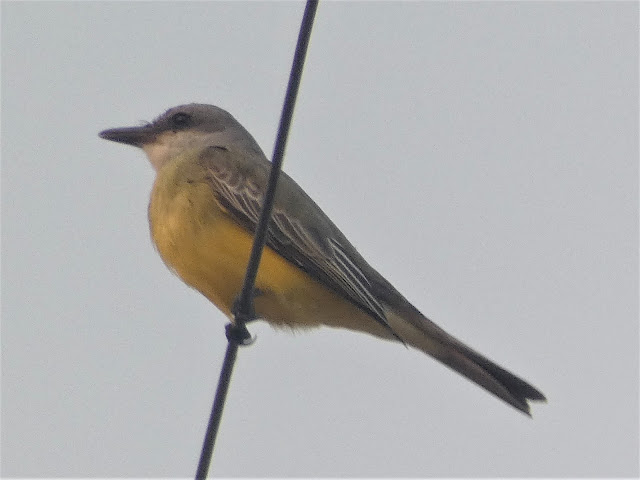
But as I was snapping the  photos, I  realized something was missing. Western Kingbirds usually have a white strip on the flanks of their tail feathers, and this bird didn't have those. So in my intimate knowledge of the local bird possibilities (rolling of eyes allowed here), I thought of a Cassin's Kingbird (Tyrannus vociferans). This would be kind of exciting because although they've been found in other parts of the county (even the MJC campus), they've never been sighted on the Tuolumne River Parkway Trail. So I took more pictures looking for the white-tipped tail feathers that identify the Cassin's. 

They weren't there. So that was kind of quandary, but I have learned that late in the season the birds feathers can become worn with use and the white coloration might not be visible. I reported the sighting on eBird as an out-of-season Western Kingbird and sent the pictures to a few birders for advice, and moved on to other things. It bothered me though that I couldn't nail down the identification.

A few hours later I get an email telling me that I had photographed what is most likely a Tropical Kingbird (Tyrannus melancholicus). This is even more exciting because not only has it never been seen on the Tuolumne River, it's never been seen in the entire county! This is a bird that is native to South and Central America, Mexico, the southernmost tip of Texas, and the southeastern corner of Arizona. Vagrants wander into California every year, but they stay almost entirely along the coastal zone. 

I've been wondering where this bird came from, and it occurs to me that this could be one of the sad effects of the California wildfires. I can imagine birds being driven from their habitats by these terrible and extensive fires, looking for food and water. That's my hypothesis, in any case. 

The only reason it isn't absolutely, positively a Tropical Kingbird is because there is a practically identical bird called the Couch's Kingbird, which has been seen in the state of California only about three times. The only real way to tell them apart is by hearing their song, which is very high-pitched, meaning I couldn't have heard it even if it was singing. Understandably there will be a group of birders on the trail tomorrow hoping for a sight (and a listen). I hope it's still there!